

If you’ve been following my writing for a while, you’ll know that I strongly believe in fashion’s political significance. What we wear tells stories about who we are, what we value, and the world we live in. More than trends or aesthetics, clothing reflects entire systems of power: who gets to be seen, who is expected to change, and who is allowed comfort, beauty, or freedom.
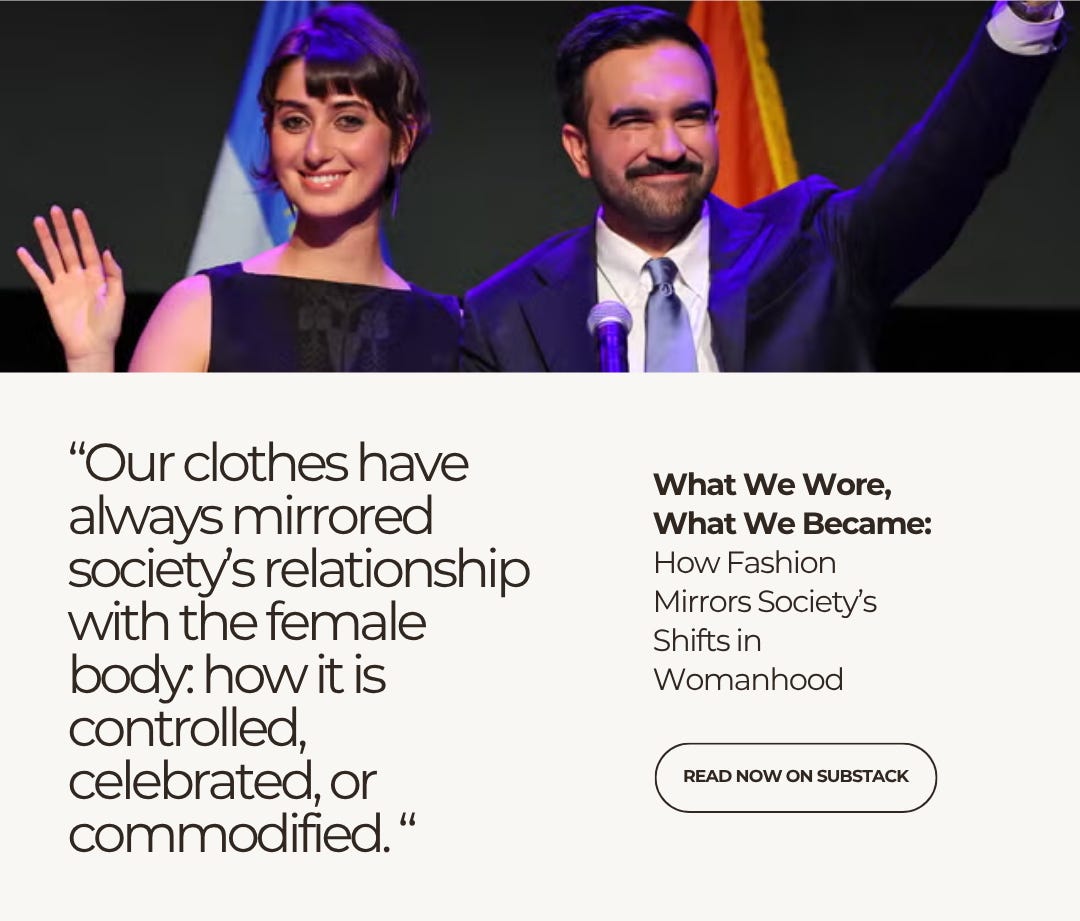
Fashion doesn’t exist in a vacuum; it moves in rhythm with social change. Every silhouette, from the corset to the power suit, carries traces of the time it was born into, its politics, its anxieties and its ideals of womanhood. Our clothes have always mirrored society’s relationship with the female body: how it is controlled, celebrated, or commodified. This affirms Meyda Yeğenoğlu’s argument that women’s bodies are “at the centre of the techniques of colonial control and domination.”
Even in politics, women’s fashion choices are scrutinised in ways that most male politicians easily escape (though, of course, we all remember Obama’s tan suit “scandal”). Just yesterday, after Zohran Mamdani was elected mayor of New York, my feed was filled with commentary not only about his policies, but about his wife’s “unusual” fashion choices as the future “First Lady of New York.” Comments like “Where is her hijab?” and “No Muslim pyjamas?” may sit on the extreme end of the spectrum with their explicitly racist undertone, but they also contribute to the broader phenomenon of women in public life still being judged first by their appearance.
To continue on this news story, when major fashion houses or their founders engage in political funding, the stakes become even clearer. According to Time magazine, the Lauder family (of Estée Lauder) spent $2.6 million opposing Mamdani’s campaign, while New York Magazine reported that Michael Kors donated $50,000 in support of Andrew Cuomo. Whatever one thinks about the ethics of such involvement, it makes one thing undeniable: fashion has never been, and will never be, apolitical.
To look at fashion, then, is to look at history itself, not just through fabric and form, but through the shifting expectations placed upon wearers. Each era redefines what it means to be a man or a woman, and fashion, in turn, becomes the mirror that reflects those changing definitions back at us.
The 18th & 19th Centuries: Femininity as Duty
In the 18th and 19th centuries, womanhood was tightly bound to ideas of morality, modesty, and service. A “good woman” was defined by her ability to nurture, endure, and restrain, qualities that were not only social expectations but moral imperatives. Ashley Wood points out that “The social pressure to maintain the pure image of an ‘angel in the house’” stood in direct contrast with the “identification as a fallen woman.” Thus, clothing became one of the clearest ways to communicate a woman’s virtues.
The silhouettes of the time, cinched waists, layered petticoats, and laced corsets, did more than shape the body; they signified discipline, obedience, and control. To dress properly was to conform. These garments spoke of purity and self-restraint, reinforcing the belief that femininity itself was a form of moral duty.
Industrialisation and empire deepened these divides. As Britain’s global reach expanded, so too did the hierarchies of class, gender, and race that underpinned it. Middle- and upper-class women were expected to embody domestic virtue, dressed beautifully, but confined to private life, while poorer women and colonised subjects provided the invisible labour that sustained this ideal. This was even reflected in some of the textiles themselves, as Lauren Miskin points out, “The sort of irreproachable whiteness esteemed in spotless muslins became central to the establishment of gendered ideals of sexual purity as well as British identity.” The fabric of femininity, quite literally, was woven through systems of production, exploitation, and empire.
The 20th Century: Liberation, Work, and the Modern Woman
The 20th century brought revolutions in politics, work, and fashion. Each decade reflected a new negotiation between freedom and expectation, between empowerment and appearance.
The 1920s flapper discarded corsets and moral restraint alike, but she represented more an ideal than a universal reality. For a generation of mostly urban, middle-class women, loose silhouettes, short hemlines, and bobbed hair became emblems of freedom, a rebellion against their mothers’ constraints. They danced, smoked, and occupied public spaces in ways that challenged convention. Yet this liberation was uneven. Working-class women, women of colour, and those outside large cities rarely shared the same freedoms. Still, the flapper’s image captured a cultural shift: clothing became a language of rebellion, and style itself an assertion of autonomy.
By the 1940s, fashion had to adapt to the demands of war. Women stepped into workplaces and uniforms once reserved for men, trading luxury for practicality. Yet, the post-war years of the 1950s reinstated domestic ideals, characterised by full skirts, cinched waists, and polished perfection, a visual reminder that women were expected to return home once the fighting stopped.
Then came the 1970s and 80s: women entered boardrooms, universities, and parliaments in greater numbers, and the power suit became the new uniform of liberation. Sharp shoulders and tailored lines projected authority, but they also mimicked masculine codes of power, a reminder that freedom often came with the condition of conformity. In my discussion of Superfine, we saw a similar subversion of the suit aesthetic in a different context.
Throughout the century, fashion reflected a constant push and pull: women claiming space, while society quietly rewrote the boundaries of what that freedom should look like.
The 21st Century: Choice, Change, and the Fluid Body
The 21st century promised freedom and, in many ways, it delivered. Fashion became more democratic than ever before, shaped by feminism, digital culture, and the language of choice. We can dress for power, comfort, rebellion, or self-expression. Yet even this freedom exists within tension. Capitalism has learned to sell empowerment back to us, transforming liberation into lifestyle branding. The message is often less about freedom from expectation and more about buying the right version of it.
Still, something real is shifting. Conversations about body inclusivity, gender expression, and sustainability have changed how we think about clothes and the bodies that wear them. We are slowly moving away from fashion that confines, toward fashion that adapts, clothing that recognises movement, emotion, and evolution as part of life itself.
At The Female Archetypes, this belief sits at the heart of what we create. Our adjustable, functional pieces are not designed to control the body, but to honour it, through every stage, every change, every version of womanhood. If the clothing once symbolised containment, the clothes of today can symbolise release: garments that move with us rather than against us.
What Clothes Reveal About Us
If fashion portrays womanhood, shaping how women are seen, constrained, or celebrated, what does it say about us now? Today, style reflects more than aesthetic taste: it mirrors how society continues to define women’s roles, freedoms, and worth. Every era has used fabric to tell a story about what women should be. Now, we have the chance to rewrite that story ourselves.
Fashion no longer needs to dictate; it can express. It can evolve with us, reflect who we are in motion, not a fixed ideal, but a living, changing identity.
At The Female Archetypes, we believe adaptability is the new form of empowerment. Our clothes are made to move with you, to honour every version of who you are becoming. Because fashion should never restrict your evolution, it should accompany it.
Written by Jasmine Niblett, 09.11.2025