

My doctor said something recently that’s stuck with me ever since: “We spend our whole lives trying to figure out our hormones, and just as we get there, menopause makes us start all over again.” It’s true. Fatigue, cramps, bloating, mood swings, sleep that won’t cooperate, appetite that won’t behave, most of us are constantly trying to manage our hormones, right until perimenopause resets everything again and we’re lost again.
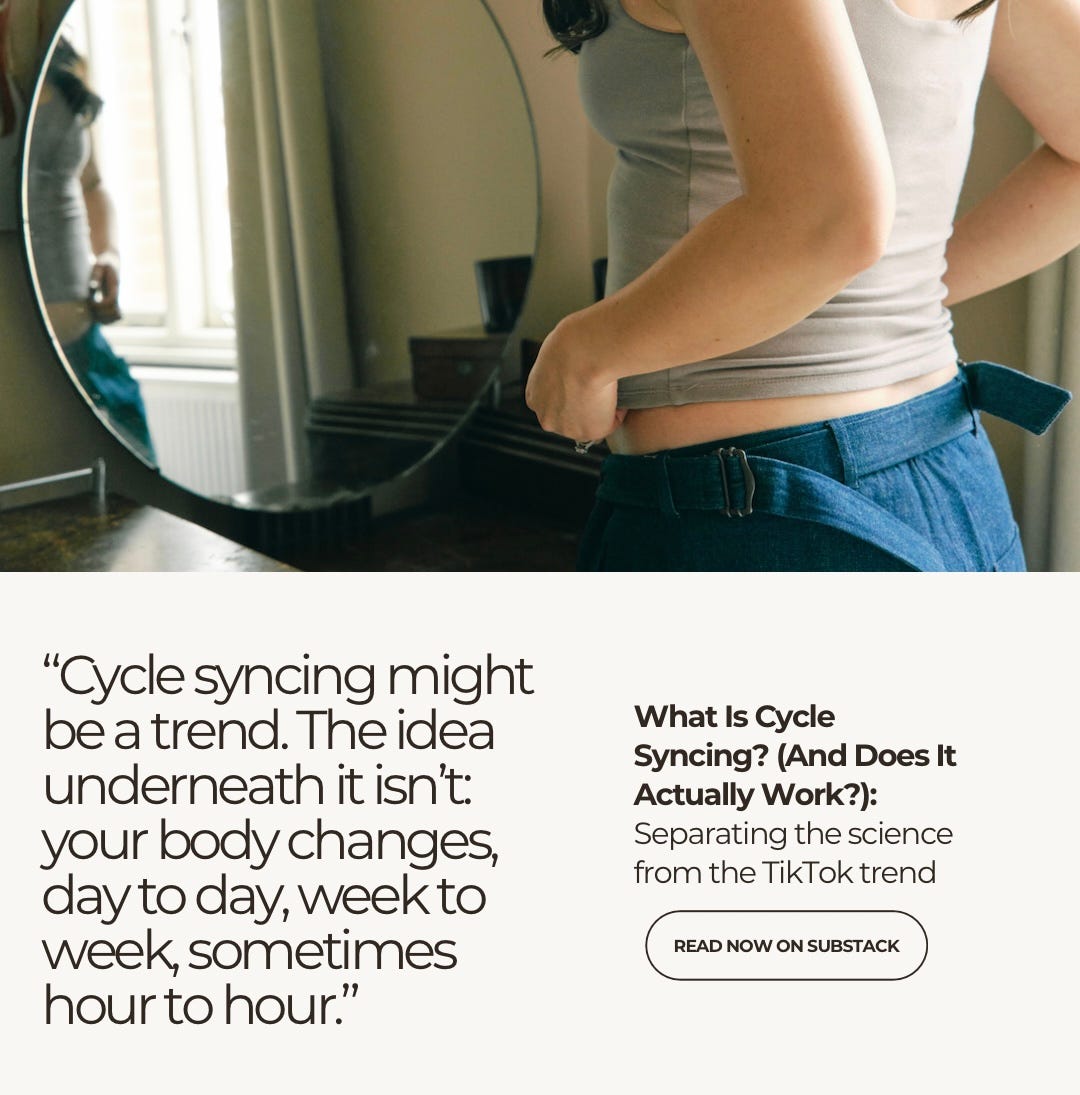
The latest proposed solution is a practise called cycle syncing. Cycle syncing proposes that if you adapt your lifestyle and eating habits to the phase of your menstrual cycle, you can mitigate its effects. Somewhere in the last few years, cycle syncing went from a niche wellness concept to a full TikTok category. Eat differently in your luteal phase. Train differently in your follicular phase. Schedule big meetings around ovulation, rest around your period. An entire content genre now exists to tell you exactly how to live according to which week it is.
But how much of this is actually helpful, and how much is just another trend that puts pressure on us women to be responsible for things we can’t control?
The Origins of Cycle Syncing
According to Women’s Health, cycle syncing was originally developed for elite athletes and first reported on by them in 2020, while Holland & Barrett suggest the term was first coined by functional nutritionist Alisa Vitti in her 2014 book, WomanCode. A woman’s cycle typically lasts about 28 days, though many experience significant variation (this is important since research has found that irregular cycles impact exercise and diet). Across this cycle, we move through four phases: menstrual, follicular, ovulation, and luteal, during which our hormones, most notably oestrogen, progesterone and testosterone, rise and fall significantly. Olympic athletes began meticulously tracking their cycles and training in line with them to chase marginal gains in performance.
The purported scientific backing gives cycle syncing a credibility that’s rare among the wellness advice flooding the internet, which is a large part of its appeal. And the underlying premise isn’t in dispute: hormones do shift our energy, mood and stress across the cycle and across life stages. It feels only natural, then, to adapt our habits accordingly. Baylor Scott & White Health suggests cycle syncing may be particularly useful through perimenopause, noting that as oestrogen begins to drop, it can leave you feeling tired and unmotivated. Healthline also names a range of conditions including polycystic ovarian syndrome (PCOS), endometriosis, premenstrual syndrome, premenstrual dysphoric disorder (PMDD) and premenstrual exacerbation (PME) that cycle syncing could be beneficial for.
However, research outcomes aren’t as hard and fast as some might want you to believe. As early as 2022, CNN reported that the four-phase framework cycle syncing relies on is a simplification, clinical and scientific research typically works with two primary phases, not the four popularised online. Much of the specific advice attached to cycle syncing, what food to eat and which workouts to do, is more prescriptive than the science supports. Despite how confidently cycle syncing is presented online, there’s no direct research evaluating whether cycle syncing itself actually produces the benefits it claims, and the older research it draws on is genuinely mixed.
So what’s actually helpful here, and what’s just adding another layer of rules and restrictions to an already difficult area of our lives?
Exercise and Fitness
When it comes to exercise, exercise physiologist Dr Alyssa Olenick says it is most helpful to think in two phases alongside scientific advice: the follicular phase, the first two weeks of your cycle, including menstruation and ovulation, and the luteal phase, the final two weeks. Although, of course, the length of a cycle is individual to each woman, and not every woman will have a four-week cycle. Olenick notes that while menstruation and ovulation are often perceived as distinct phases, there is little evidence to support training differently across these phases, though symptoms may vary among the four phases.
The research backs this up. Emma Hogan notes that hormonal shifts across the cycle may cause fluctuations in metabolism, body temperature, and injury risk, with the strongest evidence for body temperature, real changes, but not ones that necessarily translate into a worse workout. Women’s Health goes further, citing evidence that while a long-term decline in hormones (aka menopause) can affect muscular adaptation, short-term monthly fluctuations don’t have a significant effect and that following a generic cycle-syncing plan could, in some cases, work against your fitness goals rather than for them. This means it is very much a case of doing what feels good for you, giving yourself a break if you need it, or working out if it will make you feel better.
Harvard, in collaboration with the Apple Women’s Health Study, sums it up simply: exercise is beneficial at every stage of the cycle. The most useful approach isn’t a phase-based training plan, it’s moving in whatever way feels good and possible for your body that day.
Food and Nutrition
Plenty of creators and advisors talk about tailoring your diet to your cycle, but there’s far less clarity on what that actually looks like compared to, say, cycle-specific workouts (see Emily Pfender et al.).
Many widely trusted sources, including the London Clinic of Nutrition and Holland & Barrett, have published comprehensive guides on which foods and supplements are particularly beneficial or necessary at each phase of your cycle. In their medically reviewed article, H&B’s medically reviewed advice is that syncing your diet with your cycle might help support your body’s natural processes and ease PMS symptoms over the course of the month. The London Clinic of Nutrition goes further, suggesting the menstrual phase is a good time to avoid heavily processed foods, alcohol, spicy foods and sugar, since these may worsen inflammation-related period pain, and that prioritising magnesium-rich foods during the follicular phase may help ward off period pain later in the cycle.
The science behind this is quite mixed. Scientific research by Anna M. Gorczyca et al. has found plausible links between macronutrient intake and menstrual cycle phases. But a review of the wider literature by Emily Pfender et al. discovered that findings on energy and nutrient intake across the menstrual cycle were inconsistent, largely because most studies don’t account for how active someone is day-to-day, which affects appetite and metabolism regardless of hormones.
So, as with everything, it’s worth taking everything with a grain of salt and, most importantly, trust your intuition. Notice how you actually feel. Test a suggestion if it’s appealing. But none of this is fixed law, and intuitive eating, paying attention to what your body is actually asking for, will tell you more than any phase-based chart will.
What is most valuable about cycle awareness?
Not the rules. Not the colour-coded calendars telling you exactly what to eat, lift or schedule on a Wednesday. What’s actually useful is much simpler: paying attention.
Knowing your cycle won’t solve everything, but it can help you understand the signals your body has been giving you all along.
Some days that means going for a run. Some days it means cancelling your plans and getting an early night. Neither is wrong. Either way, the point stands: your body isn’t the same every day, and it was never supposed to be treated like it is.
Join our community: Instagram, Youtube, TikTok, Linkedin
Written by Jasmine Niblett, 13th August 2026