

When we talk about parenthood today, its expectations, contradictions, and pressures, it’s impossible not to trace its roots back through history. Although our world looks radically different from that of the 18th century, many of the ideals that still shape our beliefs surrounding care, motherhood, and even womanhood itself were formed then.
Today, I will discuss how carework, and specifically childcare, influenced parenthood ideals during the 18th century and what this means for us today. This covers both paid care work and the less visible range of unpaid domestic care work that is often expected from women.
I must also point out that the distortion of care was worst for enslaved parents during the 18th century. They were not only denied their freedom but also the right to care for their own children. This is why I will also highlight these stark examples in history to truly grasp how care has shaped our ideas of parenthood.
The Invention of the “Natural Caregiver”
In the long 18th century, society began to cement the idea that care was a woman’s work, not just in practice, but by nature. A ‘good mother’ wasn’t simply a caretaker, she was patient, tender, and selfless by definition. Her worth was measured by her willingness to nurture, often at the expense of herself. Jane Humphries and Carmen Sarasúa suggest that this might have stemmed from religious teachings, in which it was women’s “God-given destiny” to be caring mothers.
Writers like Maria Edgeworth echoed this sentiment in literature, where a woman’s emotions, her capacity to love and sacrifice, became central to her femininity: “I can understand that there may be such a thing in nature as a jealous wife, but an unfeeling mother I cannot comprehend - that passes my powers of imagination.” This cultural script still echoes in the modern mother’s dilemma: to care, to hold it all, and to never seem tired doing so.
Childcare wasn’t seen as a full-time job; it was simply expected of mothers, often alongside helping to earn money. They were assumed to care out of instinct and ‘natural’ femininity, rather than any real understanding of children’s physical or emotional needs.
When Care Became Labour
Of course, care has never existed in a vacuum. In the 18th century, some women, particularly poorer mothers, servants and enslaved women, performed care not only for their own families but for others. Melissa Rhodes points out that wet nurses, for example, earned their living through their ability to nurture, yet were condemned for not being able to breastfeed their own children. Their maternity became a commodity.
Nowhere was this contradiction more extreme than under slavery. For example, in the 18th-century Caribbean, Black enslaved women were forced to nurse the children of their oppressors while being denied care for their own. Diana Paton demonstrates that once children were too old for their mothers to carry them on their backs while working (an extreme example of the expectations on women to perform childcare alongside work), older, unrelated women, deemed unfit for manual labour, supervised older children in large groups, preparing them for plantation work. As Emily West and R. Knight show, enslaved wet nurses’ bodies were treated as resources, their love politicised and controlled: “Once enslaved women had served their purpose as reproducers, they could be returned to field work while another lactating woman fed the children.” This is an example of why Meyda Yeğenoğlu perceives the female body as central to oppressive systems’ “techniques of domination.”
The “Mammy” stereotype that emerged from this era is still a burden on Black motherhood today. As Lesly Deschler Canossi and Zoraida Lopez-Diago note, Black mothers have long been confined to narrow roles, like “the mammy, matriarch, welfare queen, or jezebel,” denying them the same emotional range, joy, and authority that white mothers have historically been allowed.
The Shaping of Fatherhood
Men’s care, meanwhile, was reframed as provision in the 18th century: To provide financially was to care emotionally. Nancy Folbre claims that caring was not simply the work of care workers, instead, earning a wage so that one’s family could afford to be cared for was as much a “caring” occupation. Good fathers were expected to work to provide for their families as an act of care, ensuring their welfare and safety.
Yet, the 18th century also saw the beginnings of a quieter, gentler form of fatherhood. John Tosh defines 18th-century masculinity as being “about being master of one’s own house.” To achieve this ideal, fathers could not be absent from the domestic sphere. Contemporary letters describe fathers playing, being tender, and the joy of simply being present. These moments remind us that care has always been broader than we assume, it includes time, attention, responsibility, and love.
Once again, we can see how parenthood was used to control enslaved men as well as women. Enslaved fatherhood was complicated from the get-go: Fathers knew that they would not be able to provide for their children, who would be born into an exploitative system of hardship. Enslavers used fatherhood as yet another way to dehumanise enslaved men. Alexis Wells-Oghoghomeh shows that, in some cases, they even dictated who would have children together, pairing people based on strength or physical traits, stripping everyone involved of their consent and choice. She also demonstrates that Black men’s power to protect their families was stripped from them since sexual violence was weaponised “to humiliate enslaved men.” Through enslavers’ disregard for slaves’ familial structures, enslaved men were forced to become disjointed from their family structures, and the resulting stereotypes about absent Black fathers still linger in harmful ways today due to this exploitation.
Why It Matters Today
Our ideas of parenthood didn’t emerge overnight, they were shaped by centuries of culture, class, and control. When we talk about modern motherhood, “having it all,” or “balancing career and care,” we’re speaking a language inherited from systems that decided long ago who has to care (or who gets to care) and who doesn’t.
Resulting from the 18th century, fathers are commonly seen as caregivers only when the mother is absent. Fathers’ main role is often to provide, not to nurture. That dynamic, though evolving, still lingers today. Men are celebrated as ‘the fun parent’ when they take time off to be with their children. Working mothers, on the other hand, are frequently penalised for doing the same, their care seen not as devotion, but as disruption.
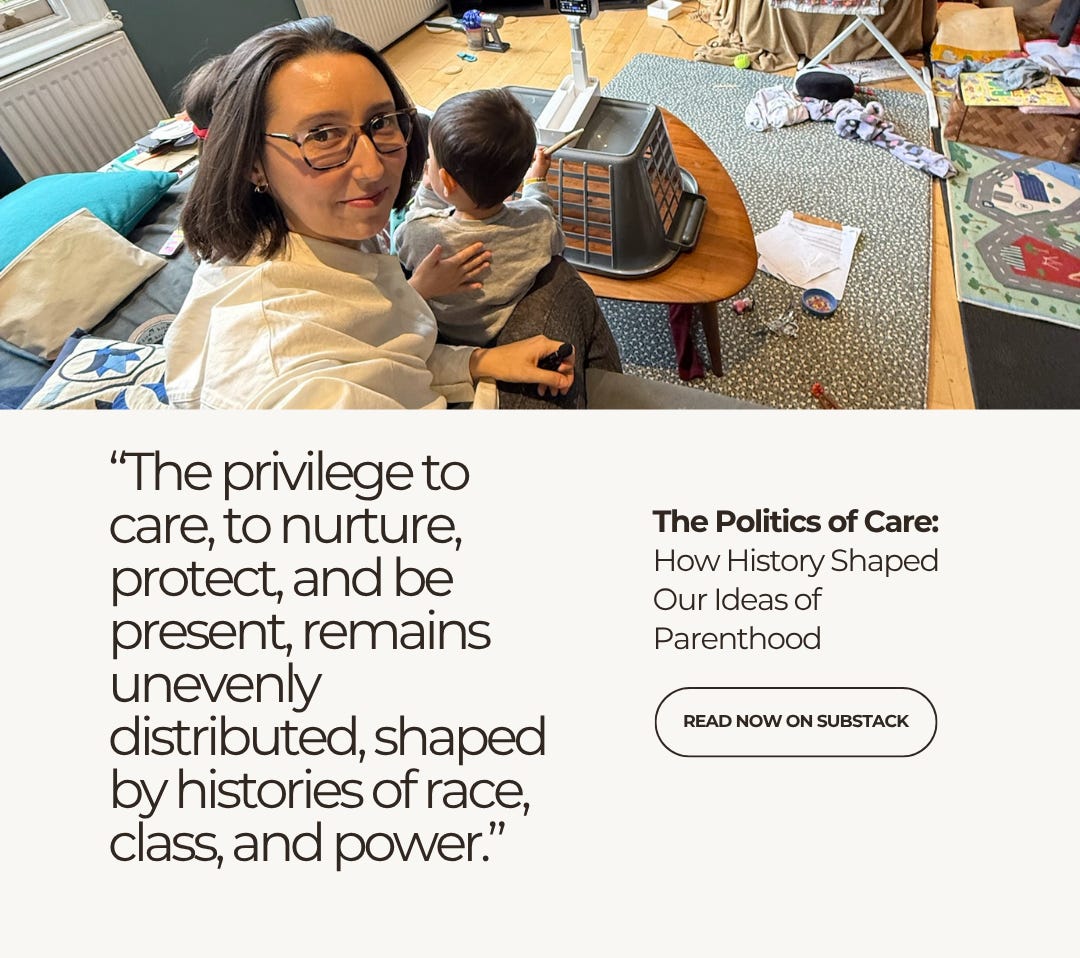
And while many of us now discuss balance, flexibility, and fulfilment in parenthood, it’s crucial to remember that these conversations still exist within a world where care, its burdens and its freedoms, are not shared equally. The privilege to care, to nurture, protect, and be present, remains unevenly distributed, shaped by histories of race, class, and power.
Written by Jasmine Niblett 26.10.2025