

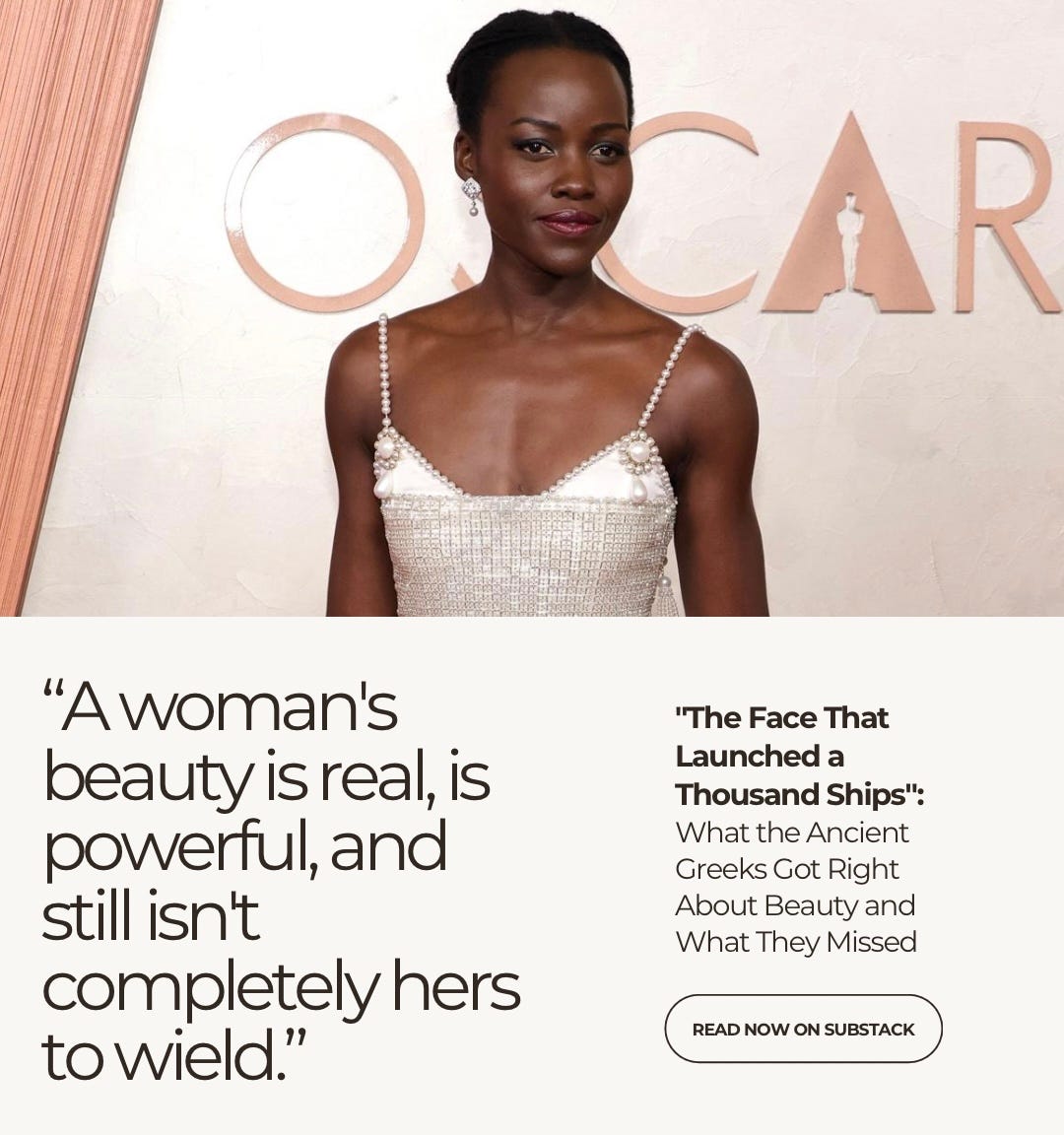
This past weekend, the long-anticipated Christopher Nolan epic The Odyssey was finally released. As soon as it was announced that this movie was in the works, everyone had an opinion on it. Unfortunately, the casting of Lupita Nyong’o has been amongst the most controversial moves, causing even Elon Musk to show off his knowledge of Greek Mythology. Especially attacking Black actress Nyong’o, who was cast as Helen of Troy, and transgender actor Elliot Page, who was cast as Sinon, Odysseus’s cousin, Musk began his X (Twitter) commentary as early as February.
This discussion and especially the commentary of classicist Prof Daniel Mendelsohn, the author of a translation of Homer’s epic poem, on which the film is based, led me to reflect on the power that beauty held in Ancient Greek civilisation and continues to hold today. In a response to Musk in The Telegraph, Mendelsohn argued, “I think it’s a deliberate choice, it’s a provocative choice and, one could argue, it’s consonant with the concern of the Troy myth, which is how to think about beauty. One of the points of the myth is to get you to think about beauty and its effects.” This article will deliberate on this: What do we see as beautiful? How can beauty be weaponised both by those who possess it and those who perceive it? Is beauty simply a concept created by vanity, or is there something more tangible to it?

Elon’s New-Found Interest in Greek Mythology
In May, Musk affirmed conservative commentator Matt Walsh in saying, “Not one person on the planet actually thinks that Lupita Nyong’o is the most beautiful woman in the world. But Christopher Nolan knows that he would be called racist if he gave the most beautiful woman role to a white woman.” Taking it even further, Musk also affirmed the conservative account C3 in saying, “The destruction of the Odyssey by Nolan and the Left isn’t just about a movie. It’s about Western Civilisation. The Greeks were its foundation. From Democracy to Art to Philosophy to Culture. The Left wants to destroy Western Civilisation and everything that helped create it.” Ultimately, Musk is claiming that Nolan is not only featuring a diverse cast to appeal to award juries but also bringing down an entire civilisation with it. As Mendelsohn aptly puts it, “Who knew that Elon Musk knew so much about the Greek legends?”
Most of us hopefully know that Musk has no idea what he is talking about, since, as Jimmy Kimmel joked on his show, “If you really want to get into it, Helen of Troy was half bird. Helen was the daughter of Zeus, (…) who disguised himself as a swan so he could mate with a human woman who then laid an egg and out hatched Helen of Troy (…) This is made up (…) So it makes no difference to anyone but crazy angry people what colour she was.” And, perhaps more importantly, Helen of Troy is a mythological figure who, while remaining important in literature and the classics, is not a verified historical figure.
But beyond this rather unnecessary discussion, we need to have a different conversation. Why was Helen perceived as beautiful, and how much agency did this beauty really afford her?
Helen In The Ancient Text
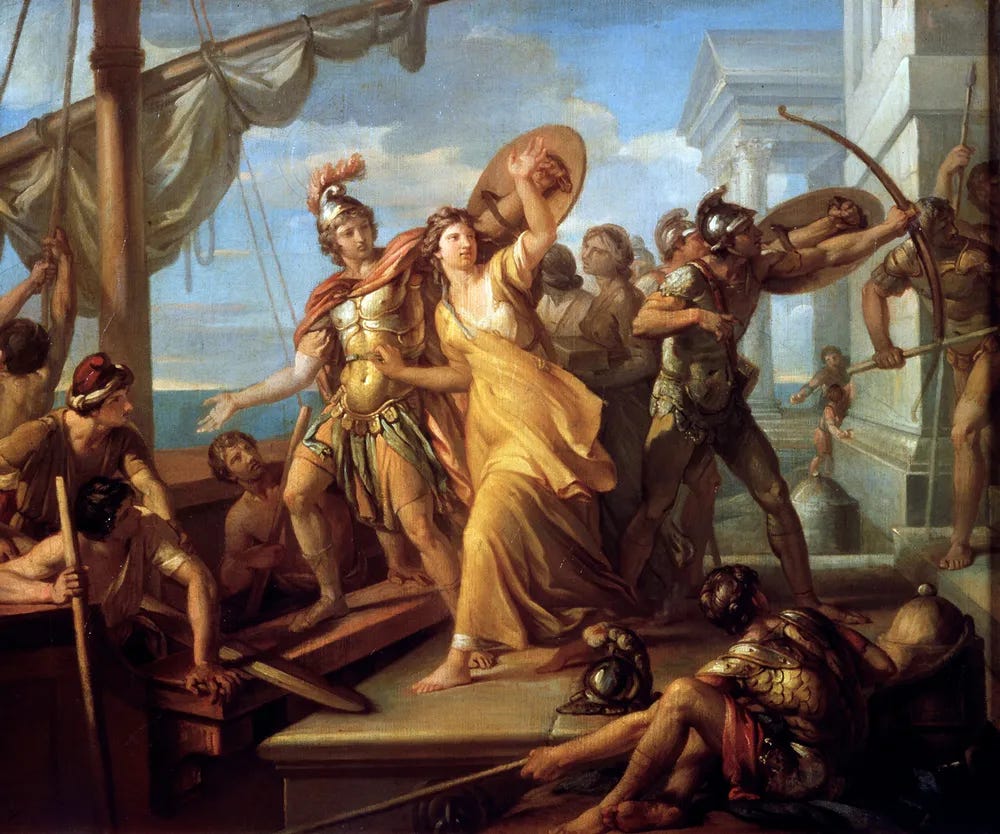
There are differing opinions on Helen and her character, with some such as George J. Ryan characterising her as “wanton, self-centered, deceitful, bewitching and beguiling”, and others such as Hanna M. Roisman describing her as “a complex and suffering figure with a good mind, who strives for autonomy, expression, and belonging, within and despite the many constraints to which she is subject.” She is and has always been a controversial figure in popular discourse, while she holds a fascination for many. Of course, the irony of this obsession with Helen and her beauty is that she doesn’t actually feature as much in the happenings of the Odyssey as some might want you to believe. There are only a handful of proper appearances of Helen in Homer’s works: 4 in the Iliad and 2 (possibly 3) in the Odyssey (this is a point of debate among classicists). But still, she is seen as the catalyst for major events of Homer’s epic, possessing “The Face That Launched a Thousand Ships.” This raises the question: What was it that made Helen so beautiful? And can we really blame the actions of the men around her on her appearance alone?
To answer the first part of this question, we must look to the descriptions of Helen in the original text. Kenneth J. Reckford claims that Homer does not explicitly describe her beauty, though other characters imply that Helen is the most beautiful woman in the world in their eyes. Instead, “Her own radiance emanates from what she says and does (…) The most that is said directly of Helen is that ‘she is terribly like the immortal goddesses to look upon.’” Beauty is projected onto her by the way men perceive her. It seems the way she carries herself and her confidence go a long way toward making the other characters believe she is as beautiful as she is. Even the Helen-critical George J. Ryan describes her as “a woman supremely confident of herself, of her beauty and charm.” This shows that her confidence must be part of what makes her attractive to the men of the Odyssey.
Helen’s beauty, described only through the actions and reactions it provokes, never through the narrator himself, is what makes her valuable to the men around her, and valuable in a very specific sense: not as something she owns, but as something they get to claim, dispute, and defend. Roisman argues that in Homer’s world “women are property, to be taken, traded, quarrelled over,” and that “the idea of woman as possession and the idea of woman as loved blend together.” Even the readings that grant Helen some agency in the fall of Troy still work within a text where the men around her treat her as an object first, something to be fought over, not consulted. Beauty in the Odyssey only exists once a man has affirmed it. Whether beauty can be a weapon in its owner’s hands is a question the myth and the men around her never let her answer.
Three thousand years on, the terms of who gets to make that call haven’t moved much. When Elon Musk backed claims that Lupita Nyong’o couldn’t be “the most beautiful woman in the world,” and by extension shouldn’t play Helen, he wasn’t making an aesthetic judgment so much as trying to assert his authority to hand that title out.
A Different Definition of Beauty
While Musk seems to have taken the archaic message of The Odyssey literally, Nolan’s new adaptation sheds new light on the ancient text, one that can actually be useful in today’s day and age. Critics have noted that Helen is, for the first time, allowed some defiance of her own, rather than existing purely as something fought over. Yet unsympathetic reviews concede the film doesn’t fully commit to that reframing: Helen remains peripheral to a story still driven by the men around her. If Homer’s Helen was valuable only insofar as men affirmed her, Nolan’s Helen is more visible, but not yet, by most accounts, given full credit for her beauty.
Beauty holds real power, in politics, in the workplace, everywhere. Research consistently shows beauty affects hiring, promotions, elections and sentencing. Yet still women are expected to navigate impossible contradictions: being attractive but effortless, stylish but not vain, lest we be painted with the same brush as Helen, “wanton, self-centred, deceitful, bewitching and beguiling”. At once, men still assume the role of judge while simultaneously blaming us for their actions in response to said beauty (“she was asking for it” rhetoric being the first to come to mind).
Allegedly, Musk’s own former partner, Ashley St Clair, has said she felt violated after his AI chatbot Grok was used to generate sexualised images of her without her consent, one case among thousands, as Grok was allegedly found to be producing roughly one nonconsensual sexualised image per minute at the height of the scandal. This is, in the end, the same war. Helen never asked to be fought over; her beauty was decided, disputed and avenged entirely by men who never consulted her. Three thousand years later, the battlefield has moved from the walls of Troy to a comment thread, but the logic hasn’t changed: a woman’s beauty is real, is powerful, and still isn’t completely hers to wield. It is all too often claimed by those who perceive it.
So, is beauty vanity, or something more tangible? The Greeks would have laughed at the question. They built an entire civilisation’s worth of myth around the premise that beauty was never trivial, never just decoration, it was a form of power serious enough to start wars over. What they perhaps failed to reckon with, and what Helen’s long silence in what is seemingly her own story makes clear, is that power exercised on someone’s behalf is not the same as power held.
Written by Jasmine Niblett, 20.07.2026