

The term “Functional Fashion” is often associated with work clothing, especially men’s safety and workwear. But why should our clothing only be functional if we are performing manual labour? Surely, clothes should work for us all the time, no matter what our job or lifestyle looks like. This is why when we use the term “Functional Fashion” at The Female Archetypes, we’re not speaking of hard hats and holster trousers, we’re talking about features that should be essential: pockets, adjustable waistbands and breathability.
Strikingly, in his novel Sartor Resartus (Latin: The Tailor Retailored), nineteenth-century Scottish essayist Thomas Carlyle was the first to discuss the functionality of clothing. According to him, the only thing separating man from beast was his use of tools and, thus, the only reason humans began wearing clothes in the first place was their ability to hold those tools in pockets. While this seems like quite an outlandish statement, it does seem logical that clothes were first and foremost intended to be functional.
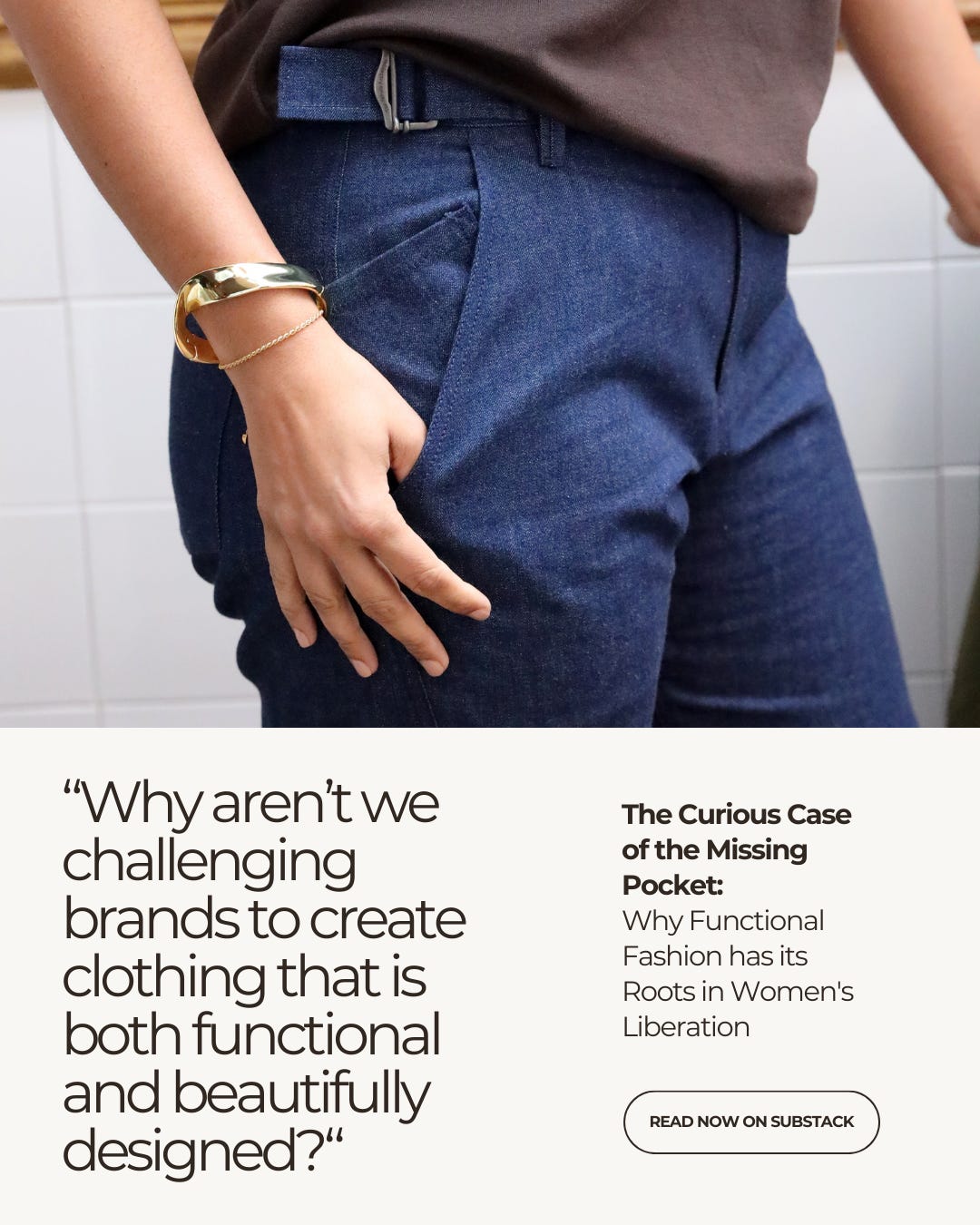
Still, I can’t tell you how many times I’ve bought a jacket online, only to find that the pockets were completely fake. Sure, it’s easy to say “pockets bulk out the silhouette,” but why are we simply accepting this excuse? Why aren’t we challenging brands to create clothing that is both functional and beautifully designed? There’s no better feeling than trying on a dress that you love and discovering that it has pockets. So why is this simplest of features that is universal to menswear, not as common in women’s clothing?
The History of Pockets
According to Hannah Carlson, Pockets, unlike bags or sacks, were first added to men’s clothing almost 500 years ago. As opposed to women, who had seperate pouches tied around their waists and worn under their petticoats, pockets allowed men easy public access to their belongings.
This distinction occurred because access to money, keys and personal belongings was seen as a symbol of independence. For centuries, most women had almost no legal access to property or income. If they were married, their possessions and their autonomy were considered their husbands’ property. Thus, there was a belief that women didn’t need pockets since they wouldn’t have anything significant to store in them anyway.
Functionality in clothing has always been tied to power. Men’s clothing was functional because it demonstrated that they were rich enough to customise their clothing to their needs. For women, however, functional clothing often implied that they were having to perform manual labour, a signal they were not of ‘high status.’ In this way, something as simple as a pocket becomes a fascinating example of how power and its symbols are layered, contradictory, and carefully enforced.
Women Start Pushing Back
Jumping forward to the late 1800s, the Rational Dress Society demanded that women’s clothing should be as functional as men’s, inspired by the American women’s rights movement of the 1850s. Madeleine Seys claims that while “rational dress” was symbolic, it also established a “connection between physical mobility and social and political progress for women.” In this vein, the famous “Suffragette Suit” with almost six pockets became a symbol of women’s rebellion and liberation in 1910.
Then the World Wars came, and women stepped into jobs previously held by men. Suddenly, society understood that women also needed trousers, uniforms, and real pockets, and for a short moment in time, functionality was seen as a necessity for everyone.
After the wars, the cultural zeitgeist shifted toward a celebration of traditional femininity. Years of utilitarian, practical clothing gave way to a renewed emphasis on elegance, domesticity, and style. Fashion reflected this shift with narrower, tighter silhouettes that prioritised appearance over function. At the same time, the handbag industry boomed, and designers increasingly removed pockets from women’s clothing, encouraging women to rely on stylish accessories rather than functional garments.
The Mystery Solved
So if you’ve ever wondered why your jeans can’t fit your phone and you’re always having to take an extra handbag everywhere you go, now you know it’s all a matter of consumerism, power and autonomy.
At The Female Archetypes, we design our clothes with real, functional pockets, deep enough for your phone, your keys and everything else. And beyond this, our clothes are functional for every aspect of your life: beautifully designed for the office but also comfortable for your morning commute, adjustable to your fluctuating body, and accommodating to your every movement. Functionality shouldn’t be an afterthought. It should be non-negotiable.
Written by Jasmine Niblett, 23.02.2026