

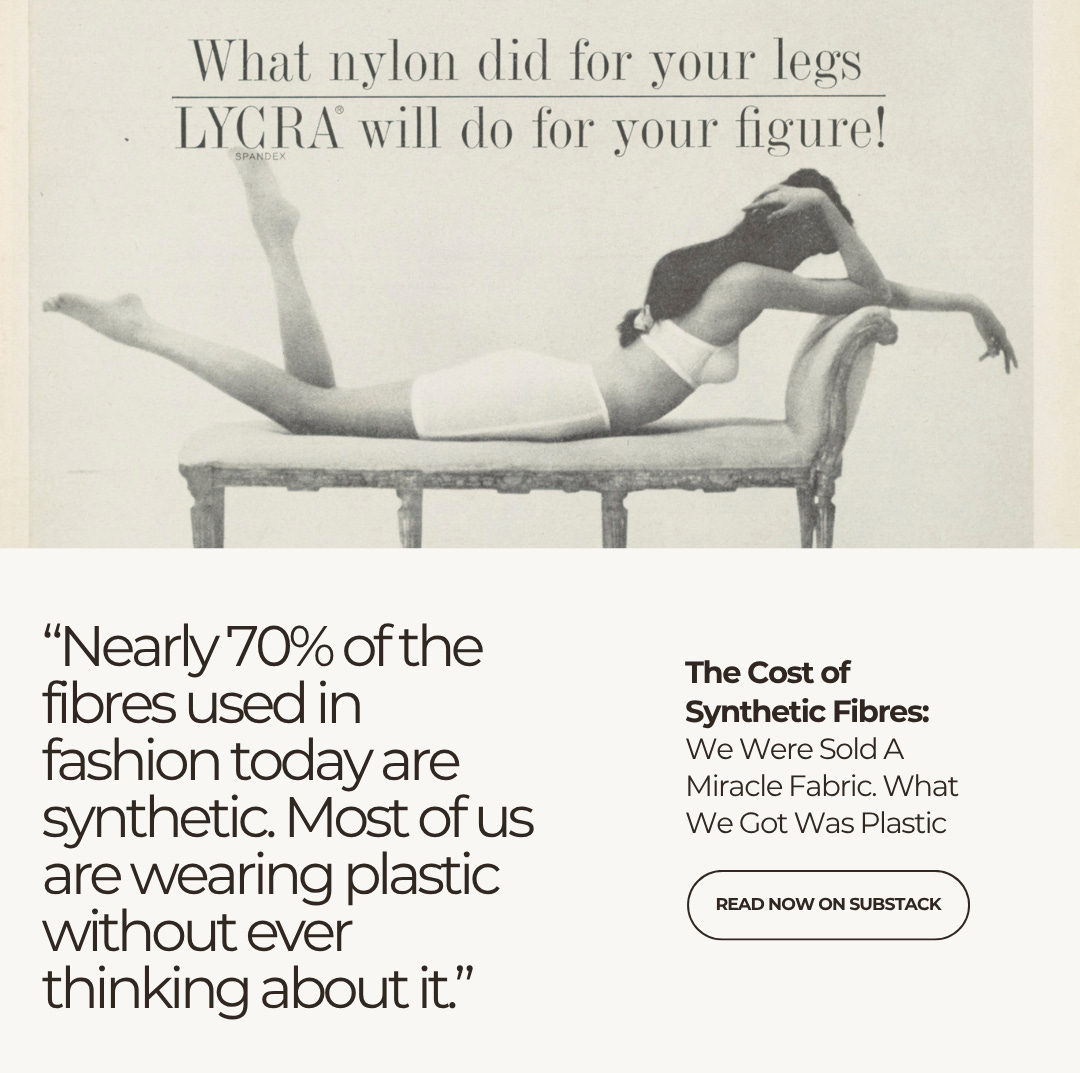
The World Before Synthetics
For thousands of years, the clothes we wore came from the world around us. Cotton from fields. Linen from flax. Wool from sheep. Silk from silkworms. While this was initially due to a lack of alternatives, these materials also had genuine functionality. In their pure form, natural fibres naturally decompose over time, minimising their long-term impact on the planet. Moreover, they work naturally with the human body, each in their own ingenious way: silk preserves the oils in our skin, wool is excellent against odour since it is antibacterial (see this fascinating study by Tomislav Ivankovic et al.), and linen is great for hot and humid weather. Then, in less than a century, we replaced them with plastic.
Today, almost 70% of the fibres used in fashion are synthetic. We often accept that as progress. But was replacing natural fibres with plastic really an improvement, or simply a cheaper way to make more clothes?
(I must note here that, of course, these natural materials have their dark histories too. Cotton is deeply intertwined with colonial exploitation, slavery and environmental degradation. Silk is tied to child labour and involves boiling or gassing silkworms alive in their cocoons to extract the intact fibres, which is why many vegans refuse to wear the material. This article is not arguing that natural materials are always perfect. There are, however, ethical sources for most of these fabrics, which include recycled and organic production. For those who are interested, Ethical Consumer has a very easy-to-understand overview here.)
The Invention That Changed Everything
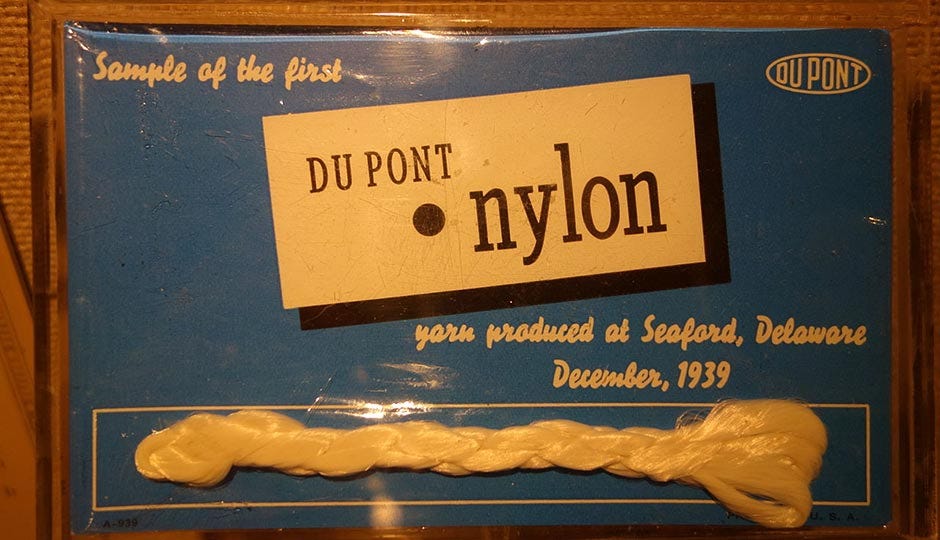
Source: Wikimedia Commons, “Sample of first DuPont nylon, December 1939 - Heritage Exhibit - Longwood Gardens”
In 1938, the chemical company DuPont announced that its researcher, Wallace Carothers, had invented the first commercially successful synthetic thermoplastic polymer (in other words, a moldable, human-made material): Nylon. According to Hillary S. Kativa, nylon was the product of 11 years of research involving more than 230 DuPont scientists and technicians. On a practical level, this new product was cheaper and easier to care for for the consumer. However, the real reason DuPont funded this project was the looming threat of World War II.
The United States relied heavily on Japan for silk, which was needed for consumer products such as women’s stockings but also for defence purposes such as military parachutes. As trade relations between the US and Japan began to deteriorate leading up to the war, DuPont sought a way to replace natural silk with a cheap, domestically produced alternative.
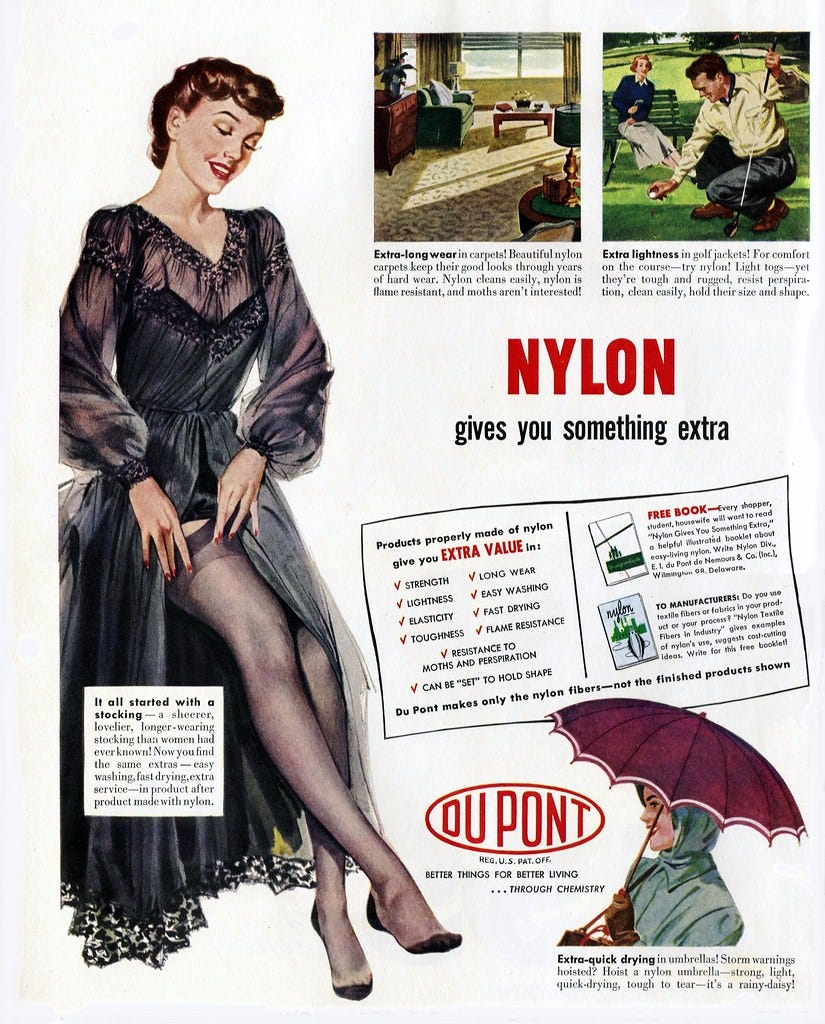
Source: Flashbak, “Bri-Nylon and the Tragic Story of Nylon’s Inventor Wallace H Carothers”
With the support of a very strong marketing machine, the invention of nylon changed fashion as we know it. DuPont described it as a “miracle fabric” that didn’t rip, didn’t wrinkle, dried quickly, and was perfect for almost any weather. As Kativa describes, nylon soon led to acrylic, polyester, and spandex, which in turn “gave rise to a mass-market fashion defined by sweater sets and wash-and-wear suits.”
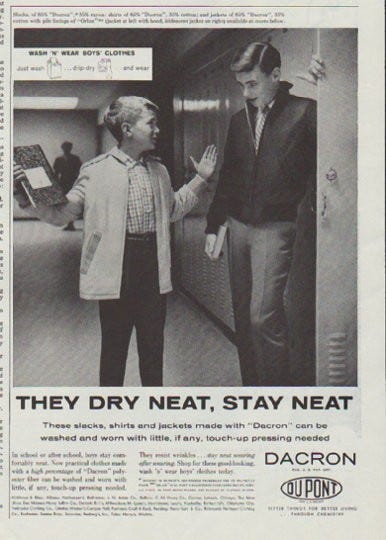
Source: ResearchGate, “Designing for the Land of Affluence: The Postwar American Dream through Synthetic Fabrics”
While Untouched World claims that polyester only officially overtook cotton production in 2000, global fibre production (see Textile Exchange) shows that combined synthetic materials were already commanding a massive share of global volume by the late 1980s, demonstrating their revolutionary impact well before the turn of the millennium. In the last 20 years, polyester production has doubled, and 69% of all fashion materials are synthetic, according to Collective Fashion Justice.
Unlike cotton or wool, which required land, were subject to unpredictable weather, and seasonal harvests, polyester could be spun endlessly in a lab at a fraction of the cost. Simultaneously, Fast Fashion brands normalised disposability, retraining consumers to view clothing as short-lived purchases rather than long-term investments. Cheapness became the primary metric of value for the modern shopper. While of course a £3 T-Shirt only feels affordable if you ignore how often you need to replace it. This trend, in turn, led to severe environmental degradation, trillions of microplastics in our oceans, and tons of unrecyclable textile waste.
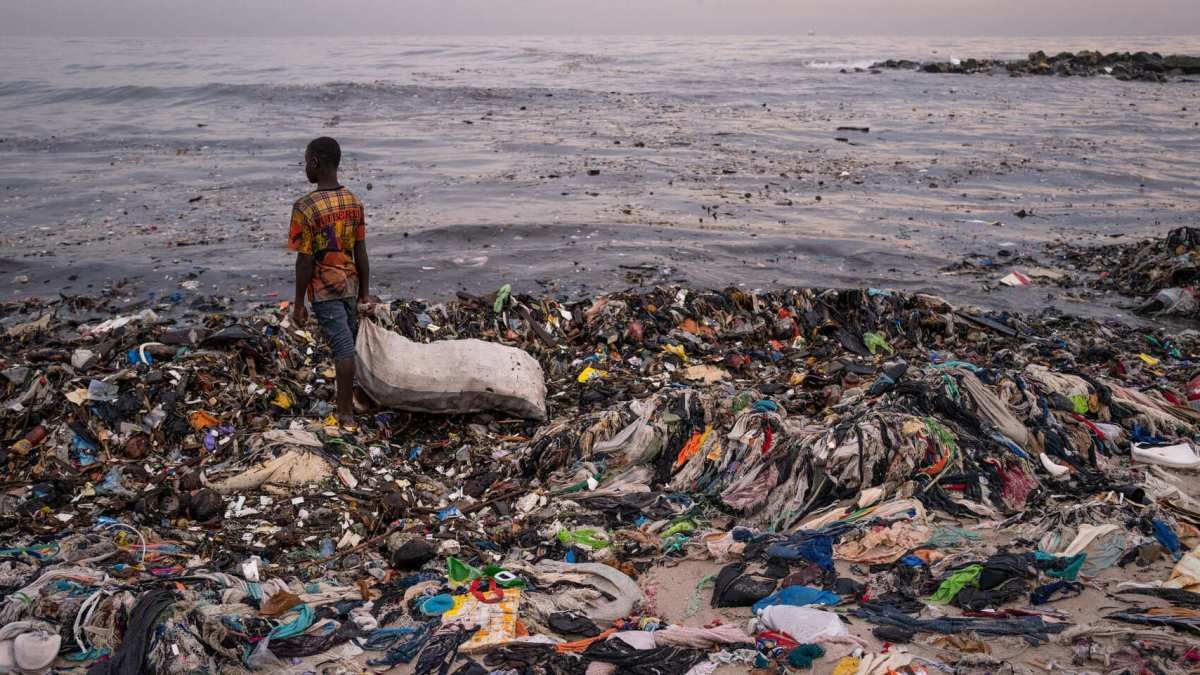
Source: Panafrican Climate Justice Alliance, “Addressing Fashion and Textile Waste Through Sustainable Water and Waste Management”
What This “Miracle Fabric” Actually Does To Your Body
By now, we all know the devastating effects these everlasting synthetic materials have had on our planet. But even without this, synthetic fibres are not all they were made out to be. While DuPont promised a material that was easy to care for, today’s polyester pills and loses its shape incredibly quickly. Moreover, this “easy care” fabric sheds microplastics with every wash, which is harmful not only to our environment and water supplies but also to the longevity of our clothing. In comparison, cotton softens over time if cared for properly, moulding to our bodies and becoming more comfortable.
These plastics could also be potentially harmful to our bodies. Synthetics are non-porous. Unlike cotton or linen, which let air circulate, they trap heat and moisture against your skin, potentially causing your body to overheat. With heatwaves as we have been experiencing lately, this is crucial, especially to women going through menopause or perimenopause. When our bodies overheat, we sweat a lot more, and what makes this worse is that synthetic fibres attract the bacteria found in human sweat. They trap body odour, making polyester garments smell bad very quickly, even after washing. In turn, the trapped sweat and bacteria can also create a breeding ground for fungal and bacterial infections, potentially leading to heat rashes, blocked pores, and flare-ups for anyone with eczema or sensitive skin.
What is less known and maybe even more dangerous is that synthetic fabrics are heavily treated with toxic chemicals during manufacturing. This includes heavy metals, flame retardants, and formaldehydes. When you sweat, your pores open, allowing your skin to absorb these chemicals. Research by Ovokeroye A. Abafe, Stuart Harrad and Mohamed Abou-Elwafa Abdallah reveals that brominated flame retardants (BFRs), which are linked to thyroid disease, hormonal and neurological issues, may leach into sweat and be absorbed through the skin.
Our Counter-Revolution
All of this is not to scare you into throwing away all your synthetic clothes. The most sustainable wardrobe is usually the one you already have. Instead, But when the time comes to replace something, it’s worth asking a simple question: What do I actually want this fabric to do?
At The Female Archetypes, our answer has always been natural fibres, which will ultimately last you longer, be kinder to your skin and may reduce your exposure to some of the chemicals commonly used in synthetic textiles. This is why the majority of our pieces are consciously made from 100% cotton. Our only exception is our white fabric, which includes a 2–5% elastane blend. Because we intentionally use fabrics already in the supply chain, we will replace this fabric only when our current supply is fully used. We promise to always clearly label these garments so you can make an informed choice.
Written by Jasmine Niblett, 06.07.2026