

Early Symptoms
When I was seventeen, I moved to Melbourne, desperate for independence. But the stress of starting over, combined with the usual turmoil of adolescence, threw my body into chaos, causing my hormones to be all over the place. Reaching a point where it was no longer manageable, I finally went to see a doctor. There, the solution was swift and impersonal: I was immediately put on the contraceptive pill. When I asked for a proper examination, I was told I was too young for an internal ultrasound. Too young, apparently, to investigate what was happening inside my own body. Old enough, though, to be medicated and sent on my way. It was my first lesson in how women’s health is often handled: quick fixes, surface-level solutions, and very little curiosity about the complexity of our bodies.
My Diagnosis
When I returned home months later, I had learned a lot about myself but was still struggling with symptoms I could not explain: hair loss, skin issues, and a lot of weight gain. Back home, I switched doctors and finally found someone willing to hear me out. My new gynaecologist, a notoriously grumpy German man with little bedside manner, did what no one else had bothered to: he ran a proper exam. Then, almost offhandedly, he said something that has stayed with me ever since: “You have higher testosterone than other women. For some, that might feel threatening, they see it as more masculine. But it’s not. It can mean you’re more confident, more decisive, stronger.” At eighteen, fragile in my femininity, his words didn’t strip anything away from me. Instead, they gave me a new lens: my body wasn’t broken or less feminine, it was simply different, maybe in need of a little more care but carrying its own kind of power.
Life with PCOS today
Now, at twenty-five, I’m still living with the consequences of PCOS, but I’m no longer at the mercy of it. I lift weights several times a week, take loads of daily supplements, and fuel myself with more protein than I ever imagined. It’s a constant balancing act, and yes, it still shapes how I feel about my body and my identity as a woman. PCOS can complicate fertility, and it ebbs and flows with age, always reminding me that control is partial at best. Yet I’ve also learned to see the unexpected gifts: stronger bones, more muscle, resilience I might never have cultivated otherwise. What’s certain is this: I don’t feel less feminine. I feel feminine in my own way, on my own terms.
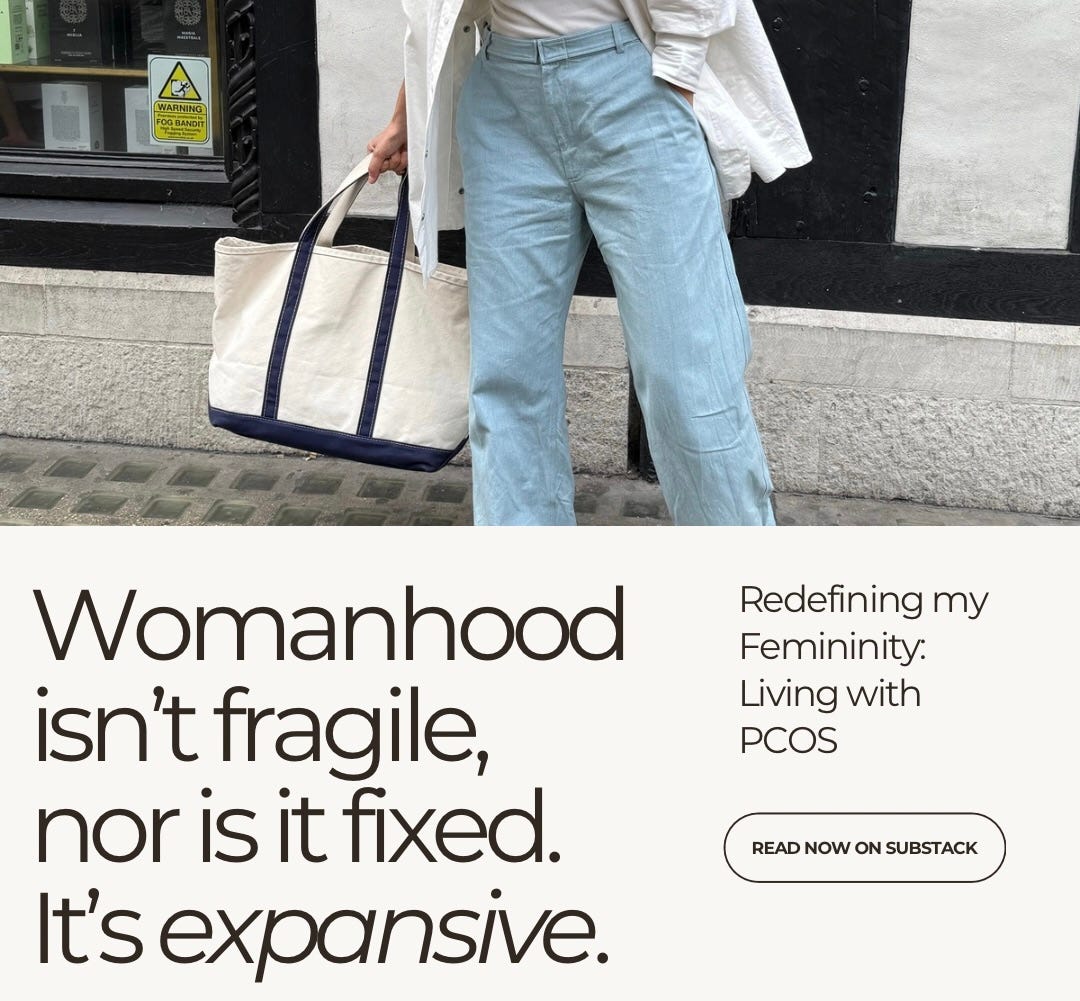
That redefinition of femininity, first offered to me in a German doctor’s blunt words, is something I carry into The Female Archetypes. Just as my own body has challenged narrow ideas of what it means to be a woman, our clothes are designed to move beyond a single version of femininity. They’re made not for one shape, one stage, or one story, but for the many forms women take: strong and soft, decisive and tender, changing and constant all at once. If PCOS has taught me anything, it’s that womanhood isn’t fragile, nor is it fixed. It’s expansive. And fashion should be, too.
A Fuller Vision of Womanhood
When I look at my journey through the lens of archetypes, I see echoes everywhere. PCOS pushes me into Artemis, strong, independent, building muscle and resilience in the gym. At times, I feel the absence of Demeter, knowing my fertility may be complicated. And then there’s Hestia, reminding me to return inward, to create stillness and strength from within. What I’ve learned is that no woman is just one archetype, just as no woman is defined by one body or one diagnosis. We shift, adapt, and carry many forms of power within us. At The Female Archetypes, that’s the truth we want our clothes to reflect: fashion not for one version of femininity, but for all the women we are, and all the archetypes we hold.
So perhaps the gift of PCOS, and of the feminine archetypes, is perspective: a reminder that womanhood is not linear, not singular, not bound to one story of fertility, softness, or perfection. Like Hestia’s flame, it is something we tend daily; like Artemis’s strength, it is something we carry in our bodies; like Demeter’s grief and resilience, it is something we feel in cycles. To embrace all of these is to embrace a fuller vision of womanhood. That is the journey I’m on, and the vision behind The Female Archetypes.
Written by Jasmine Niblett, 17.08.2025