

Once a manufacturing powerhouse, Britain used to be the global leader in textiles and clothing throughout the 19th and early 20th centuries. Today, less than 3% of clothing worn in the UK is actually made here. Still, the label “Made in Britain” holds a level of cultural prestige, one often exploited by brands to align their products within a heritage of quality and identity. In this article, I will delve into how this major shift came to be and whether there are still brands we can support that manufacture locally.
A Short History of British Clothing Manufacturing
In its heyday, the British manufacturing industry dominated much of Scotland, Lancashire, the Midlands and the English North with spinning, weaving and tailoring. ts factories supplied both domestic markets and a growing global demand. Renowned British brands such as Viyella and Courtaulds became household names, celebrated both at home and abroad.
It’s important to keep in mind that this dominance came at a cost, especially for women and children who formed much of the underpaid and unprotected workforce, with workplace accidents being common and often deadly. While the wages were initially high, Robert Allen suggests that spinners’ high wages prompted many of the inventions and innovations of the late eighteenth century. Thus, Jane Humphries and Benjamin Schneider argue that while the demand for British textiles kept increasing workers’ wages did not rise correspondingly: “This extension of production pulled hundreds of thousands of women, children, and families into the textile labour pool, providing them with income in the medium term but also making many reliant on a sector that would have no need for their hand spinning by the end of the eighteenth century.”
Moreover, when British manufacturing ultimately declined after the Second World War, thousands of people who had managed to persevere throughout industrialisation were left without jobs and security. Globalisation, cheap overseas labour, and trade liberalisation caused the economy to shift, and British production became too expensive to compete. This trend continues till today: the UK clothing manufacturing industry continues to shrink, with projections showing revenue dropping at a drastic rate of about 6% per year. In places like Leicester, once a garment hub, the number of factories has plunged from 1.500 to fewer than 100.
What “Made In Britain” means today
Ultimately, the UK textile and fashion industry does still provide many jobs, around 1.3 million jobs to be exact. However, the portion of manufacturing in this number is small at 260,000 or 20% according to the UKFT. One important factor for this decline, besides rising costs, is policy. For decades, there’s been little government investment or protection for local manufacturers. So even when brands want to produce here, the infrastructure does not exist anymore.
As a result, many brands claim to be UK-based, however, they do not actually produce their clothes here. They may design and develop their clothes here, but all manufacturing takes place abroad. The label “Made in Britain” is often reduced to a mere facade. For instance, Viyella proudly announces on their website that their “stylish men’s socks are Made in England,” however, that all other manufacturing was moved abroad is conveniently overlooked. Similarly, another heritage brand, Dr Martens, famously moved their manufacturing from Northamptonshire to China and Thailand in 2002.
Earlier this year, Marie Claire joyfully proclaimed that “‘Made In Britain’ Is Making A Comeback.” So which brands actually produce locally? Household names include Christys’ Hats and Pickett London, both proud heritage brands. Many of these brands are expensive for consumers to buy and aligned with the preferences of a more conservative, traditional consumer base. However, they also often come with the assurance of quality that the “Made in Britain” label used to afford, thus, these garments are made to last. A great, while by no means extensive, resource to use is British Made Clothing, where Rory Ferguson created a “directory dedicated to clothing and shoe brands that proudly manufacture their products in the United Kingdom.”
At The Female Archetypes, we are proud to stand alongside this heritage of British brands. Every piece is designed, developed, and produced in London, with many of our fabrics thoughtfully sourced from materials already in existence within the UK. This allows us to say, with complete confidence, that we are truly “Made in Britain.” More than that, our designs embody timelessness and versatility, ensuring that you never have to choose between personal style and locally made quality.
The Future of the UK Textile Industry
So, how can we support local production? First and foremost, by challenging the brands we buy from. This principle applies across all areas of sustainability. As consumers, we now have unprecedented access to brands through social media, making it easier than ever to ask questions about their practices. The more we speak up, the more pressure brands face to act responsibly and with transparency.
In their “Reshoring for Real” recommendations, the UKFT suggests brands should deepen partnerships with UK factories, manufacturers should invest in technology, quality, and ethics, and policymakers must incentivise sustainable innovation to rebuild a transparent, circular, and competitive domestic apparel industry, “Creating green growth, jobs and investment while reducing carbon and environmental impacts.”
And some changes have already taken place, for example, the Procurement Act of 2023 has allowed public buyers to favour local manufacturing. Moreover, a few heritage brands are returning to the UK: Vogue Business reported earlier this year that Mulberry’s CEO, Andrea Baldo, is betting on local production to get the brand back to its original excellence.
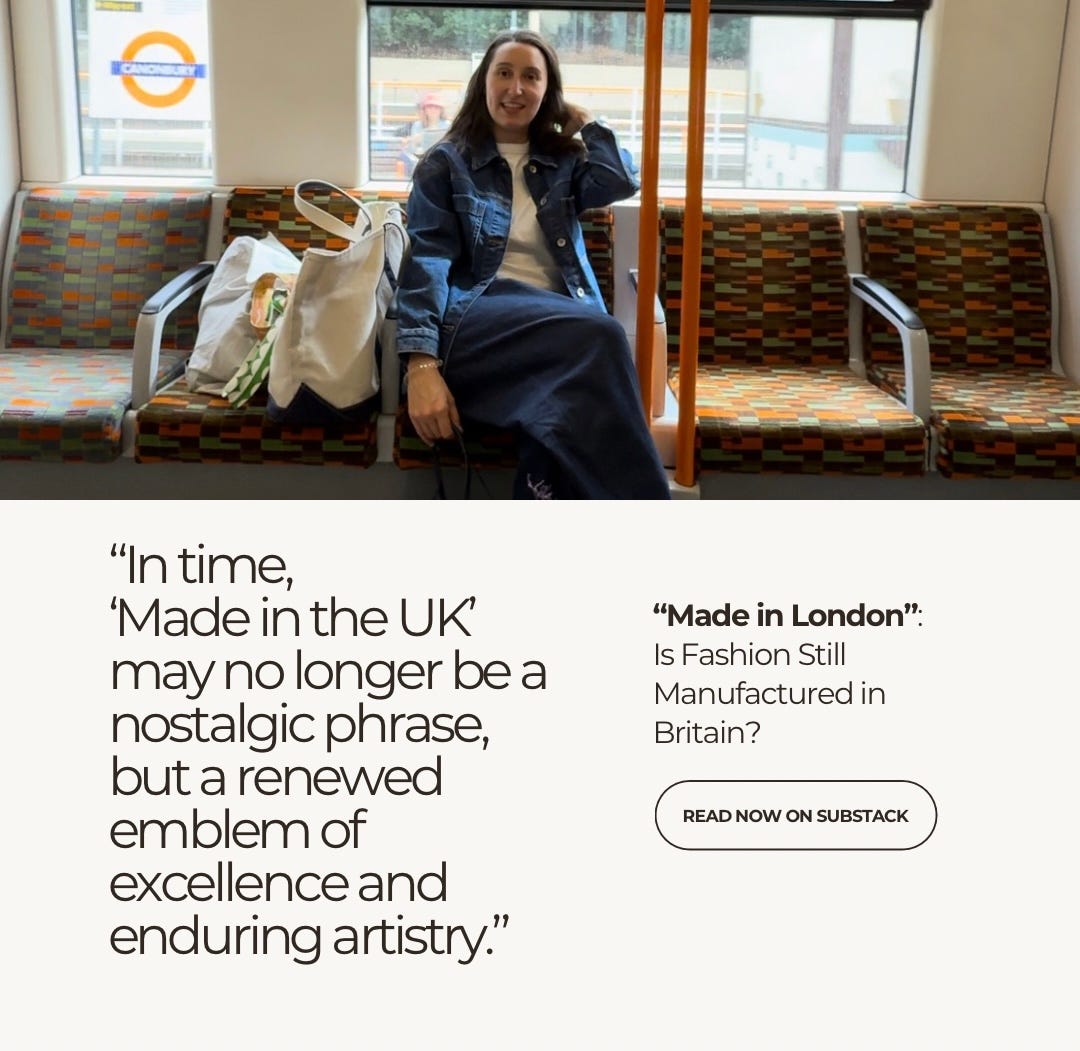
Hopefully, in time, “Made in the UK” may no longer be a nostalgic phrase, but a renewed emblem of excellence and enduring artistry.
Written by Jasmine Niblett, 19.10.2025