

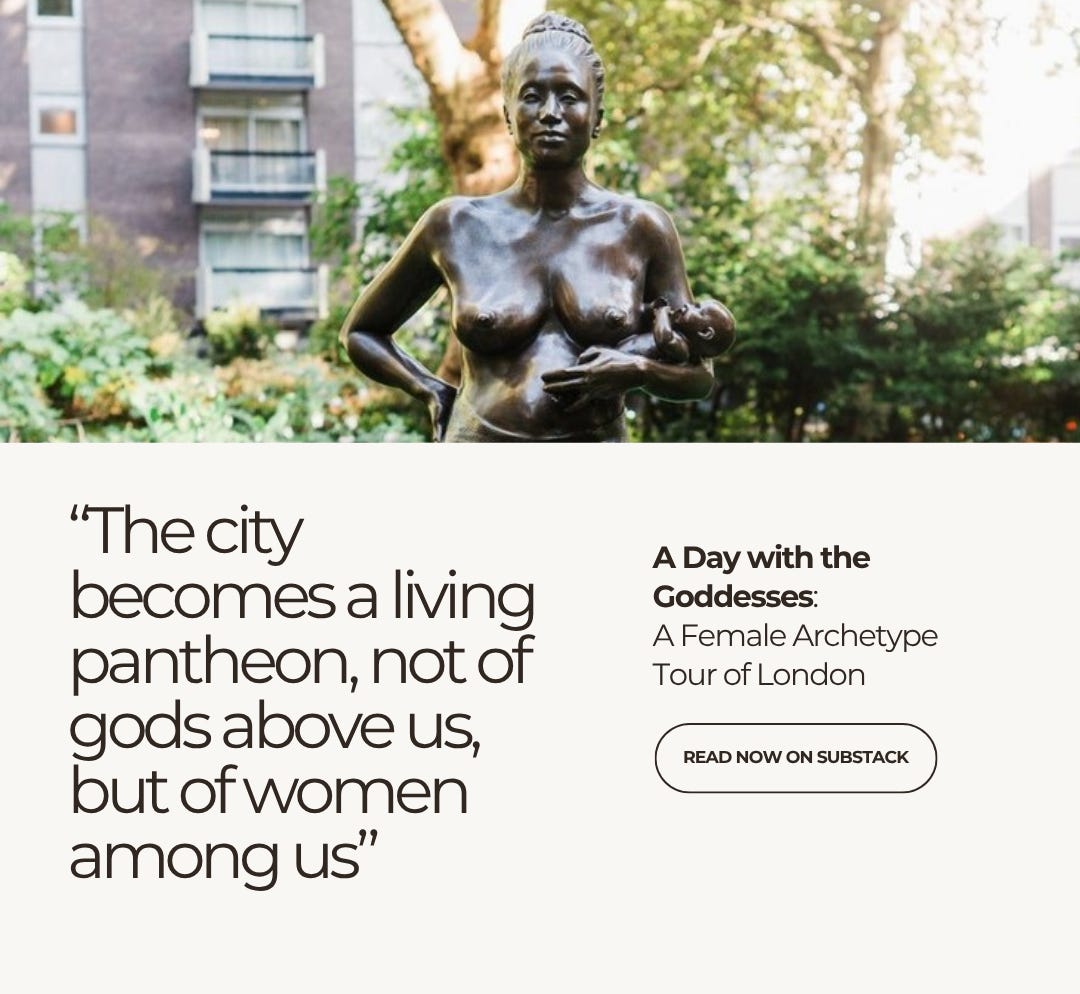
London: a city so central to our mission at The Female Archetypes. A great city that many of us love for its vibrancy and layered history. Yet its monuments and statues tell a complex story, one that clearly shows us who is represented in the historical record and who is often forgotten. Carved in marble and cast in bronze, most of the statues are of History’s so-called “Great Men.”
So this week, I set out to find the others. The women. The archetypes. I have created a route through London with a theme in mind, tracing how the feminine archetypes show up in London’s public art. Some of them are literal representations of the Greek goddesses, while I had to be a little more creative with others. In this post, I’d like to take you on this route with me, so you too can explore the faces of courage, creativity, and sovereignty that shape London’s quieter artistic landscape.
A quick disclaimer: this walk covers a considerable amount of ground and could easily be split over a couple of days. Alternatively, London’s excellent public transport makes it simple to hop between stops if you prefer a lighter pace. You can find the full route, with walking distances and travel times, on my Wanderlog map.
Before we begin, it’s worth noting that one could probably find most, if not all, of the goddesses linked to the feminine archetypes within the British Museum. Yet I’ve deliberately chosen to leave that space out of this walk. The museum’s history of displaying stolen artefacts, particularly from Greece and other parts of the Mediterranean, where many of these goddesses originate, makes it an uneasy setting for this walk. To me, seeking the feminine mainly among London’s living streets, rather than behind contested glass, feels like the truer pilgrimage.
Celebrating Postpartum Motherhood through Mother Vérité
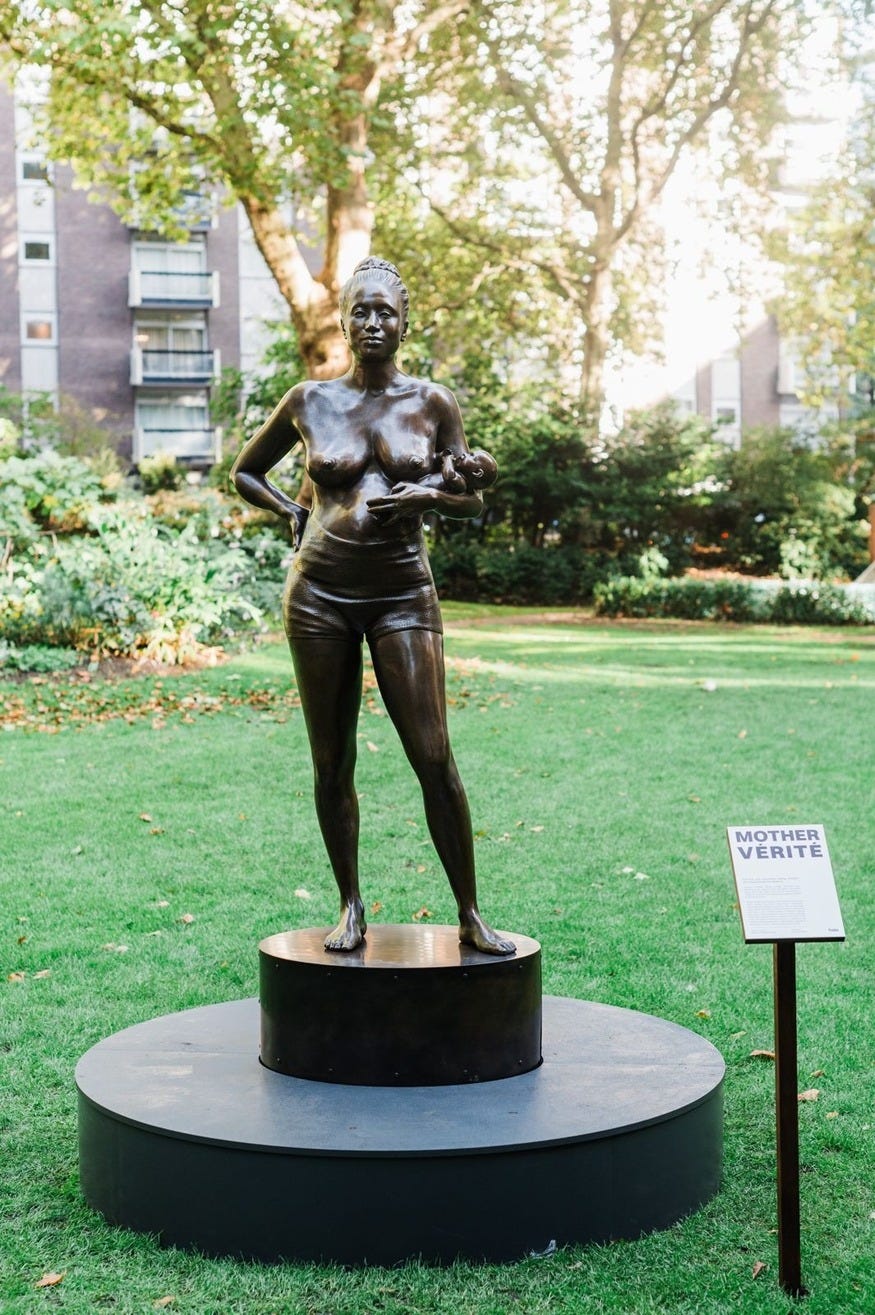
Let’s start our day with one of the most exciting statues on this list: sculptor Rayvenn Shaleigha D’Clark’s Mother Vérité, London’s “first postpartum statue.” Conceived by Chelsea Hirschhorn, the bronze figure is modelled on real women, created to “capture every scar, curve, and crease of the postpartum journey.” For The Female Archetypes, this feels like the perfect place to begin. We design for women at every stage of life, including pregnancy, postpartum, and menopause, and Mother Vérité stands as a rare public acknowledgement of those often unseen transitions. Mother Vérité embodies the archetype of Demeter, the Mother. D’Clark’s sculpture translates Demeter’s myth into the modern world, a woman marked not by perfection, but by experience. Her posture and presence remind us that creation always carries both sacrifice and strength. Unfortunately, Mother Vérité is only a temporary installation, so it’s worth visiting before it leaves at the end of October. And alternatively, Cecile Nobrega’s Bronze Woman, located outside Stockwell Station, is also a must-see. It depicts an African-Caribbean woman lifting her child toward the sky, a beautiful echo of maternal strength and renewal.
The Athenaeum Club and the Archetype of the Sage
Next, I’m sure we could all use a coffee, and where better than the aptly named Archetype Coffee to strengthen us for the day ahead?
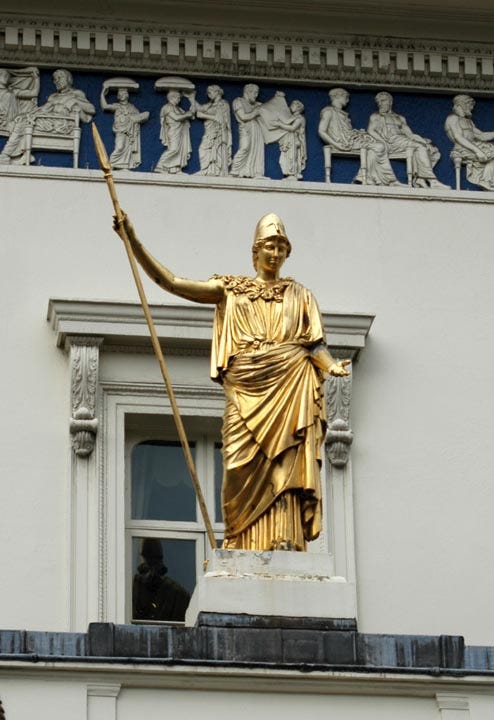
Once revived, we’ll make our way to The Athenaeum Club, whose grand Doric portico is crowned by a statue of the goddess Athena, the Sage, from whom the club takes its name. Since we can only admire her from afar, we’ll return to this archetype later in our journey, when Athena will reappear in a different, more unexpected form.
The Windrush Monument and the Strength of Generational Bonds
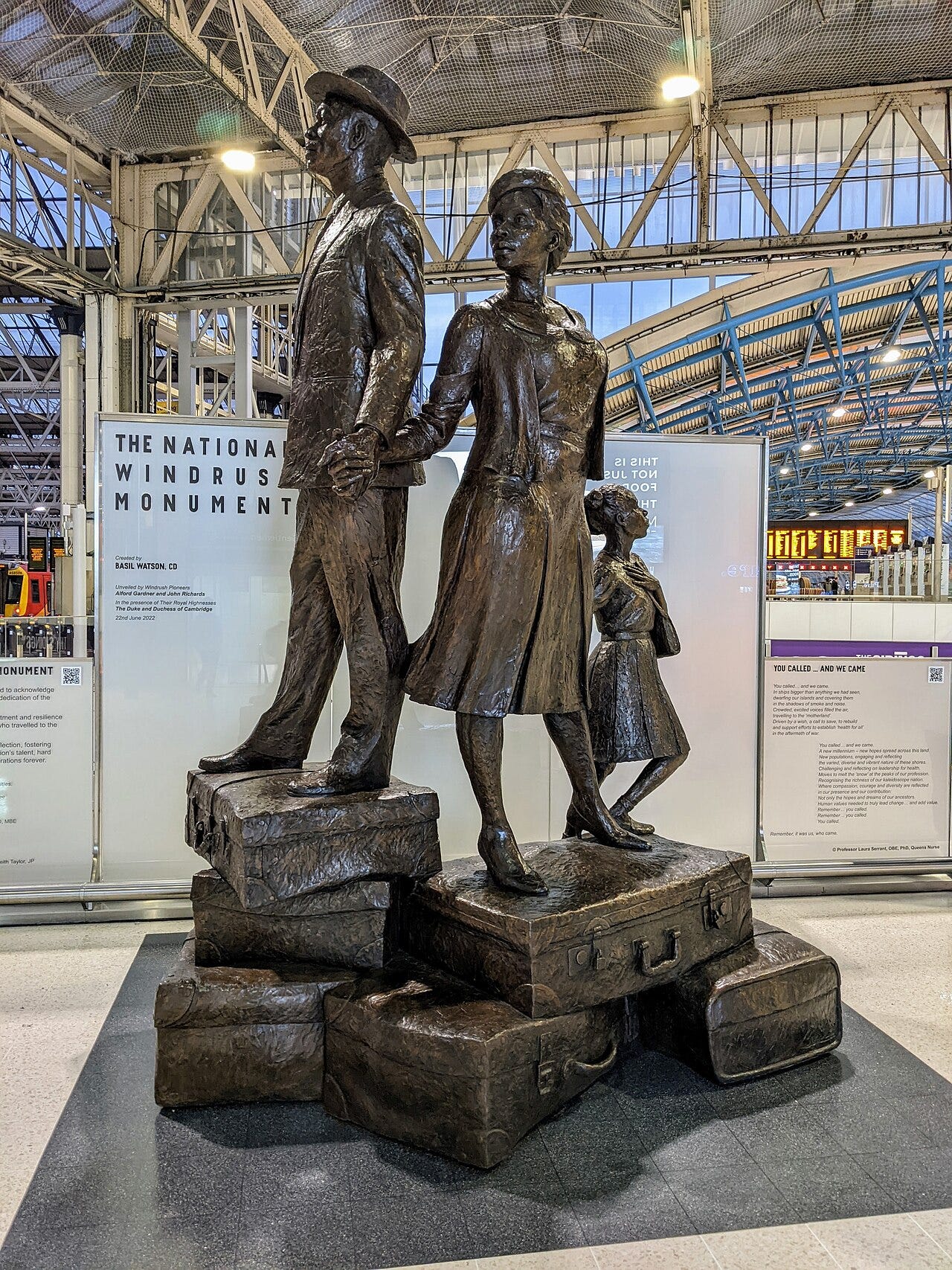
We’ll cross the river briefly to Waterloo Station to visit the National Windrush Monument. Created by sculptor Basil Watson, this striking bronze pays tribute to the dreams, ambition, and resilience of the Windrush pioneers who arrived in Britain after the Second World War, and to the generations who followed. At its heart stands a family: a mother, a father, and a daughter. The woman forms the central figure, poised, steady, and resolute. Hand in hand with her partner, she looks ahead, guiding and encouraging the child who steps forward beside her. Her strength is quiet but unmissable, the anchor of the composition. Within the framework of feminine archetypes, the mother and daughter embody Demeter and Persephone, a timeless story of protection, separation, and renewal. In this context, they become symbols of migration itself: the courage to leave, the fear of loss, and the enduring bond that ensures return. Like Demeter and Persephone, the Windrush women and their descendants carried the cycle of life, culture, and hope across an ocean, planting roots in a new world.
The Women of World War II Monument and the Spirit of Hestia
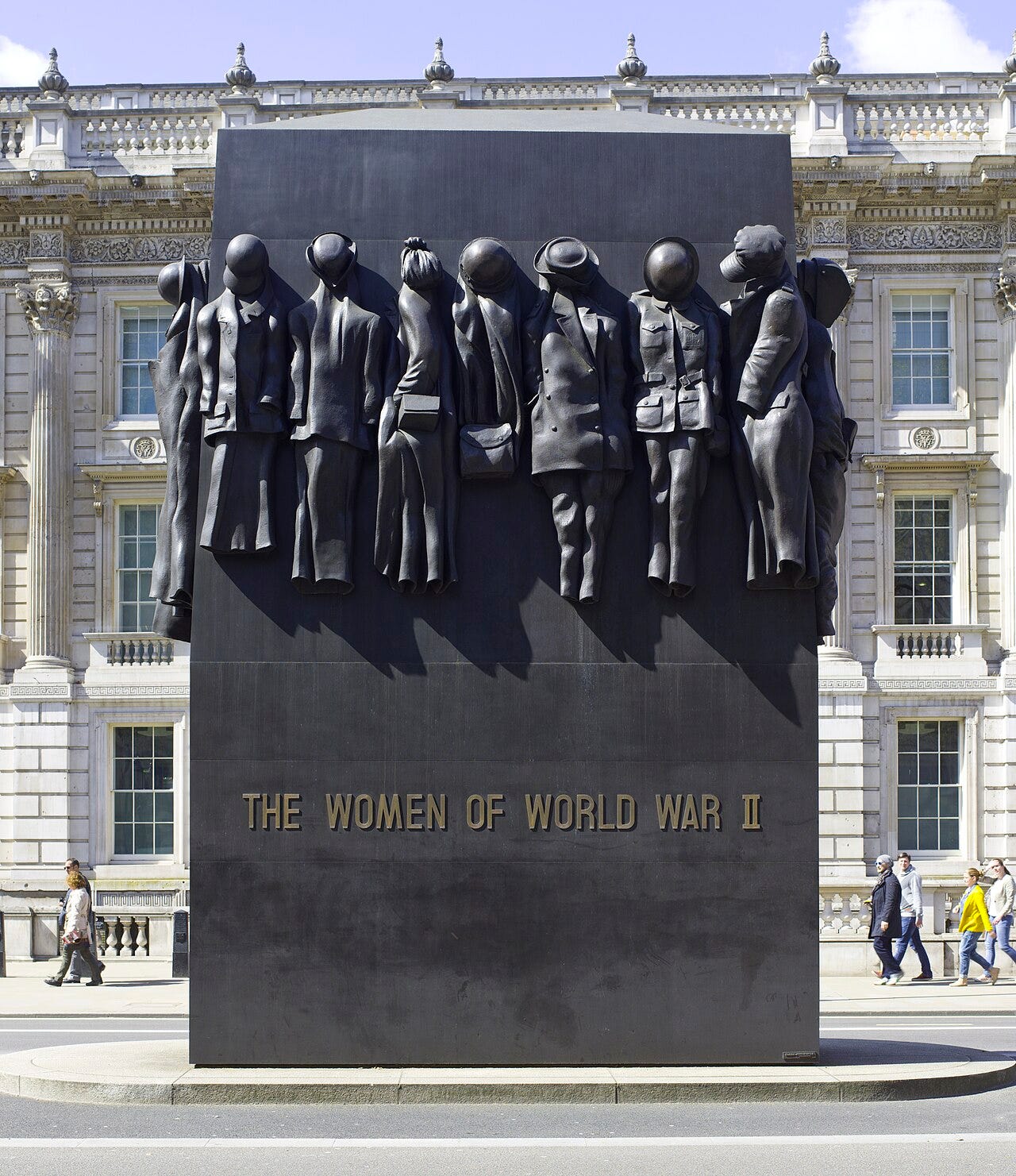
Returning to the north side of the river, we arrive at the Women of World War II Monument on Whitehall. At first glance, it may not seem to fit the pattern of goddesses and archetypes. Yet, to me, this monument speaks powerfully to Hestia, the Mystic and protector of the hearth. In Greek mythology, Hestia tends the sacred fire, the still centre around which community and family gather. During the Second World War, millions of women held that role on the home front. They kept the city running, sustained families, worked in factories, hospitals, and fields, preserving the quiet flame of everyday life while the world burned around them. Yet, when the war ended and men returned to reclaim their jobs, these women were expected to quietly hang up their uniforms, to return to domesticity, as if their contributions were only temporary. This quiet strength, this unseen labour, is exactly what Hestia embodies, devotion without recognition, stability without spectacle. The women of the monument are her modern echoes: guardians of the home, keepers of the invisible flame.
Millicent Fawcett’s Statue and the Power of Courage
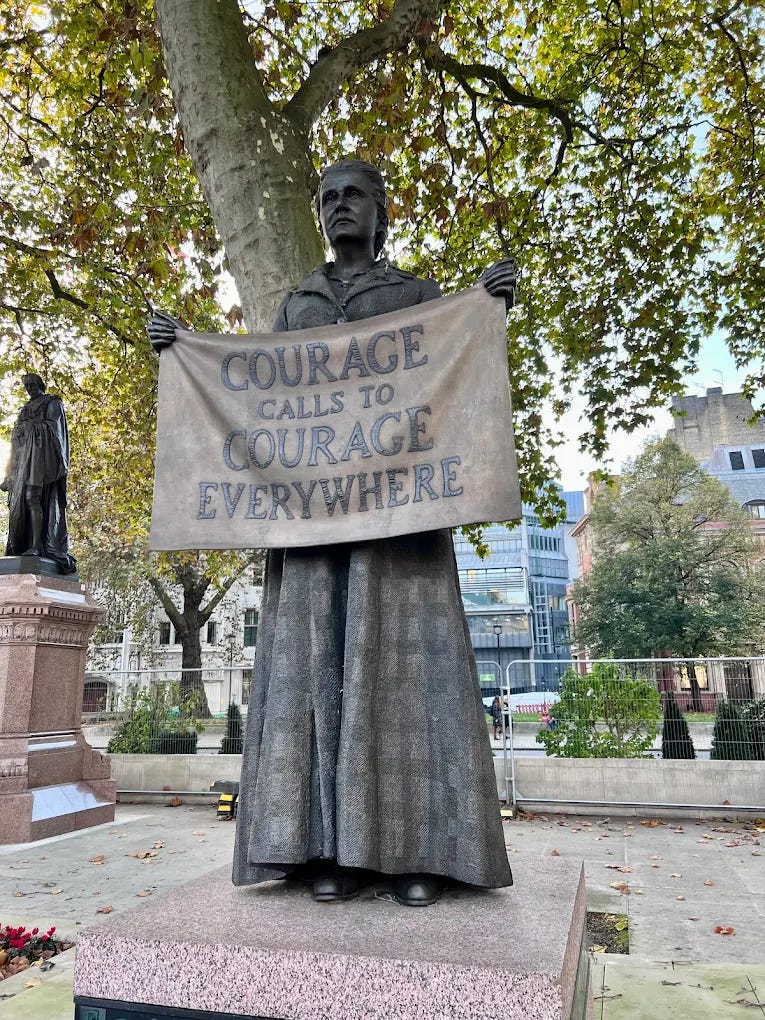
Only a five-minute walk away stands the Millicent Garrett Fawcett Statue in Parliament Square, the first monument of a woman ever placed there. Fawcett, a pioneering suffragist and leader of the women’s movement, embodies the clarity and reason of Athena, the Warrior Sage. Her gaze is steady, her stance resolute, holding a banner that reads “Courage calls to courage everywhere.” Yet beneath her intellectual poise lies a gentler resonance, the quiet compassion of Demeter. Fawcett’s activism was not born only of ideology, but also of loss: her daughter, Philippa, died young, and that grief deepened her commitment to social reform and education. In her, the mind of Athena and the heart of Demeter converge, wisdom tempered by empathy, strategy informed by care. Standing amid a square long dominated by the statues of men, Fawcett’s presence feels both defiant and restorative, a balance of reason and nurture.
The Huntress Fountain and the Spirit of Independence in Hyde Park
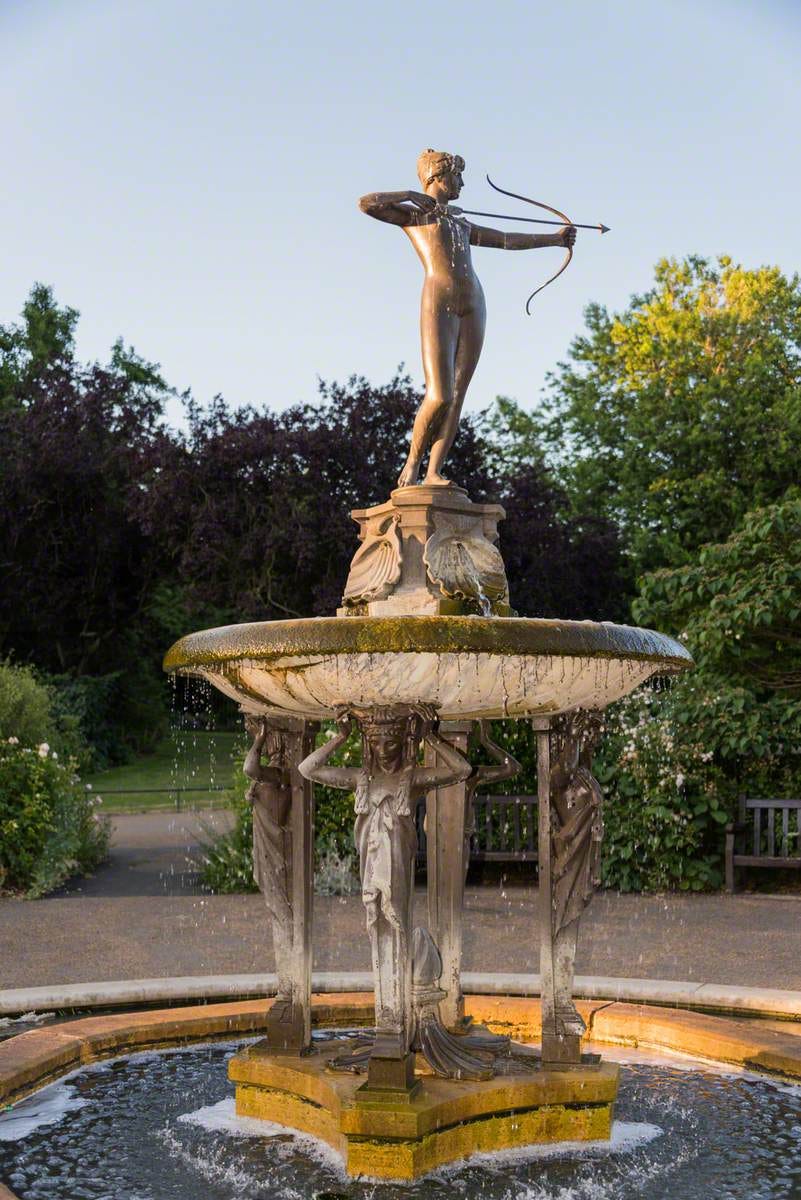
The next leg of our journey is best done by public transport as we make our way toward Hyde Park. There, at the Huntress Fountain, we find Diana, the Roman form of the Greek goddess Artemis. Artemis represents the Huntress archetype, the woman who pursues her goals with clarity, courage, and instinct. She stands for independence, self-determination, and the right to one’s own rhythm. In mythology, Artemis roamed wild forests and moonlit paths, guided by intuition and an unshakable sense of purpose. Here, in the calm of Hyde Park, she feels like a pause and a release, a moment to breathe after the intensity of the city’s monuments. Her poised bow and flowing form evoke focus and motion, yet also serenity. Within the journey of the feminine archetypes, she reminds us that freedom and purpose can coexist, that pursuit itself can be sacred.
Queen Elizabeth II’s Statue and The Complexity of The Queen Archetype
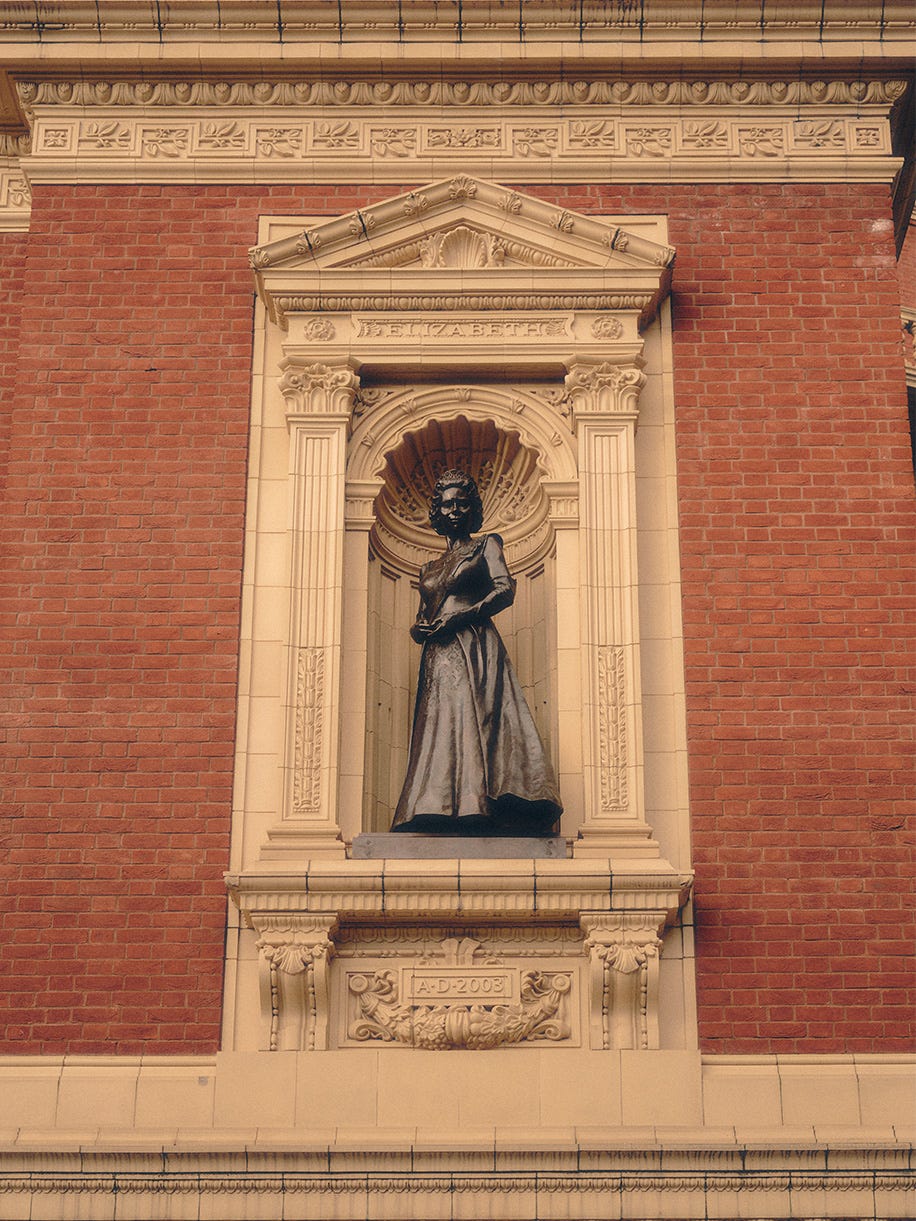
After a stroll through Hyde Park, we arrive at the Royal Albert Hall, in front of which stands London’s first statue of Queen Elizabeth II. This statue obviously embodies the Queen archetype, the woman who holds authority, steadiness, and continuity. Like Hera, the queen of Olympus, Elizabeth II represented devotion to duty. Her reign, which spanned seven decades, was marked by profound cultural and political change, yet her public image remained a symbol of stability. Still, this stability was not without complexity. The Queen’s power was largely symbolic, framed within an institution deeply entangled with Britain’s colonial history. Her figure evokes reverence, but it also prompts questions about the narratives of empire that still linger in the public imagination and about which forms of femininity are celebrated in stone. Standing before the Royal Albert Hall, itself a monument to heritage and national identity, her likeness carries both grace and contradiction. Within the spectrum of feminine archetypes, she reminds us that sovereignty can be both dignified and distant; that power, when institutionalised, often demands silence as much as strength.
The Return of the Goddesses to Olympia Exhibition Centre
If you’re feeling a little hungry by now, I’d recommend stopping at The Holland in Kensington, a fitting choice, sharing its name with our founder, Alice Holland-Lu.
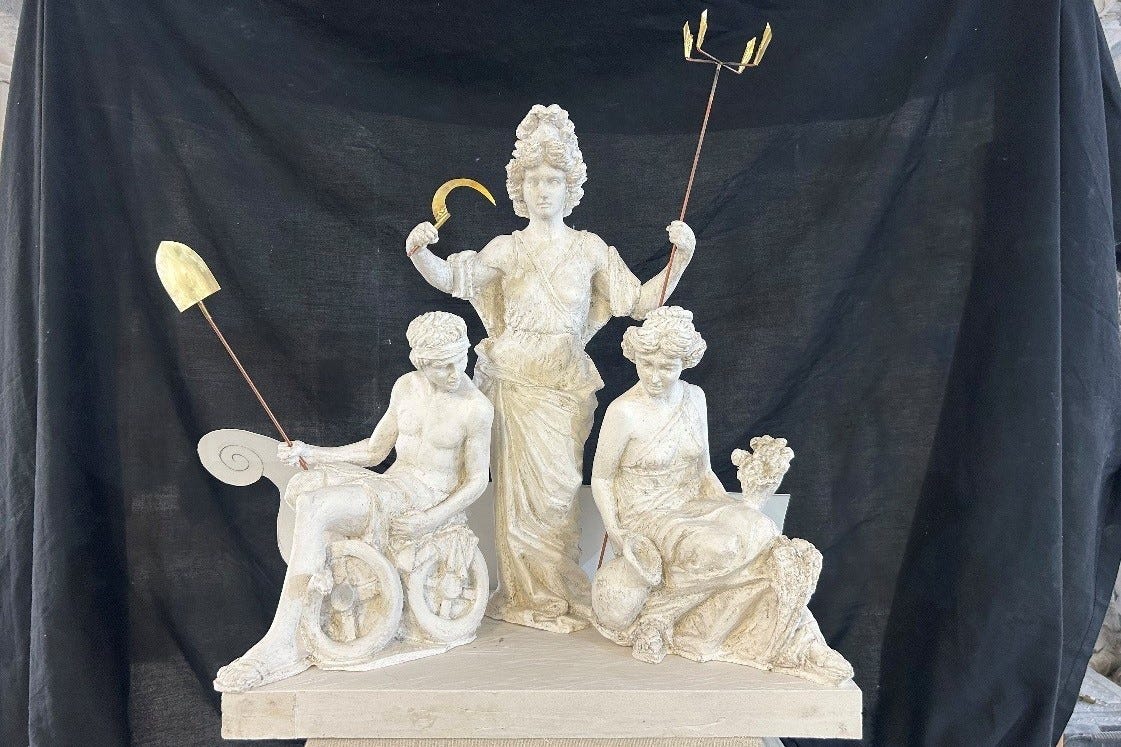
From there, you can hopefully soon head toward the Olympia Exhibition Centre, where plans are underway to reinstall the statues of Triptolemus, Demeter, and Persephone atop the Grand Hall roof. These figures, a teacher, a mother, and a maiden, represent the eternal cycle of knowledge, nurture, and rebirth. Their reinstatement feels symbolic in itself: a quiet restoration of myth to the modern skyline, a return of the sacred feminine to a space of commerce and spectacle.
Finding the Goddess of Love at Richmond Hill Terrace Gardens
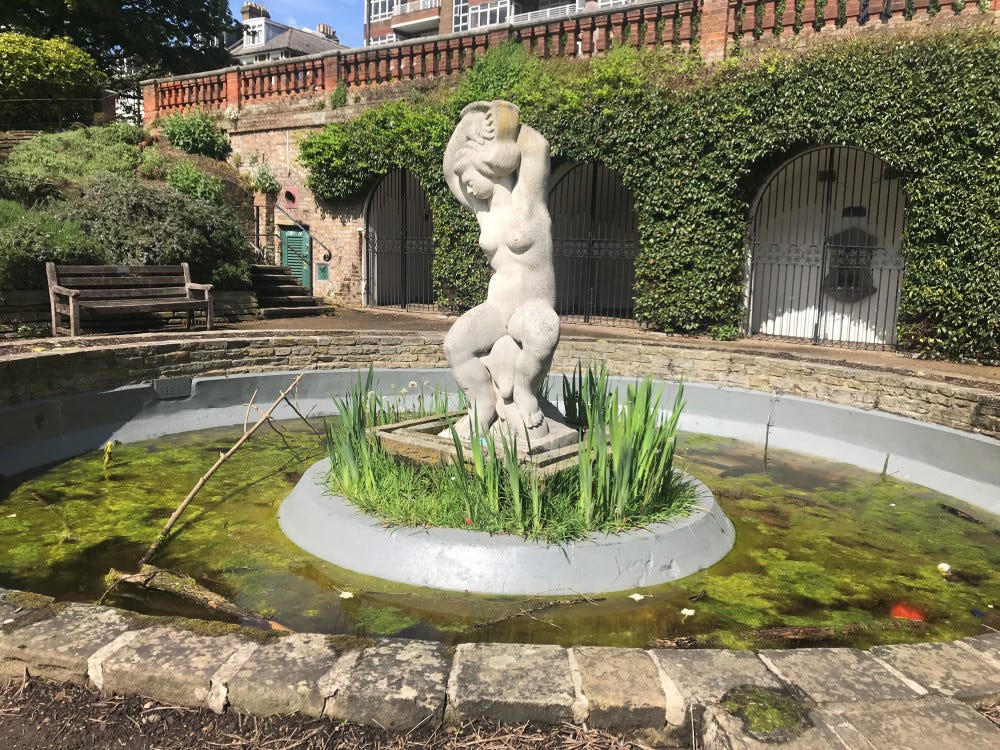
If you aren’t tired yet, I’d suggest one last stop to an archetype we haven’t yet encountered. It’s a slightly longer Tube ride, taking us down to Richmond Hill’s Terrace Gardens, where you’ll find Aphrodite, controversially nicknamed “Bulbous Betty.” Carved by Edgar Allan Howes and placed here in 1952, this statue represents the Greek goddess of love, beauty, and desire. Though modest in scale, she carries the quiet grace of Aphrodite’s archetype, the creative life force, the embodiment of sensuality, connection, and renewal. Her unfortunate nickname reflects a lingering discomfort with female form and pleasure, a reminder of how easily the sensual is trivialised, even in art. Yet, standing here amid the serenity of the gardens, Aphrodite feels reclaimed: soft, grounded, unapologetically human.
What I Learned Walking Among London’s Archetypes
Walking through London in search of its feminine archetypes is really a walk through time and through absence. These statues don’t simply represent women; they reveal where women’s stories have been overlooked. Each one carries a thread of the divine feminine, creation, courage, sovereignty, wisdom, and love, woven into the city’s fabric of empire, endurance, and change. What struck me most was their quietness. Scattered across London, they ask to be found, not flaunted, a reminder that feminine power often resides in subtlety and persistence rather than monumentality. From Demeter’s nurture in Mother Vérité, to Athena’s reason in Millicent Fawcett, Hestia’s devotion, Artemis’s independence, Hera’s sovereignty, and Aphrodite’s passion, the city becomes a living pantheon, not of gods above us, but of women among us.
Written by Jasmine Niblett, 12.10.2025